Category: interviews

  • The Happening

    The Happening

    A few years ago, my colleague and friend, artist Allison Sommers and her husband, musician and scholar, Gerrit Roessler, started to organize artist salons that took place every few months in their apartment. They were hoping to create an environment for artist friends to stretch their creative muscles.

    At these salons, music has been improvised and visual art collaborations have started. There have been mini-puppet shows, presentations of computer art in development, a myriad of sketches, paintings and sculptures, clothing, prints and jewelry on view. More wondrous things than I can list. The works are often surprising. Sculptors sing and painters bring in digital art…they cross boundaries to shake up their routines and learn new things.

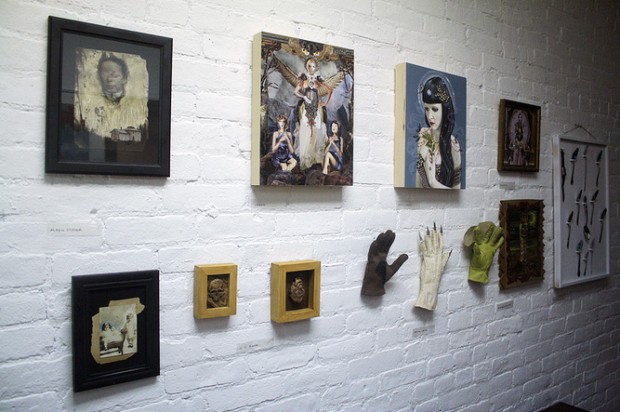
    TheHappening_YuriLeonov_2013_5

    Alison’s apartment is quite small, thus the parties are generally pretty small. There is a benefit to the size of these gatherings – the intimacy of them fosters a certain kind of conversation – but last year Allison thought that we might benefit from a larger gathering. The Happening was born.

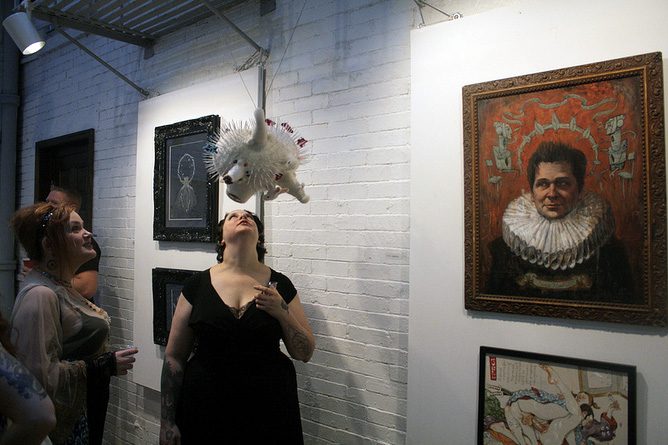
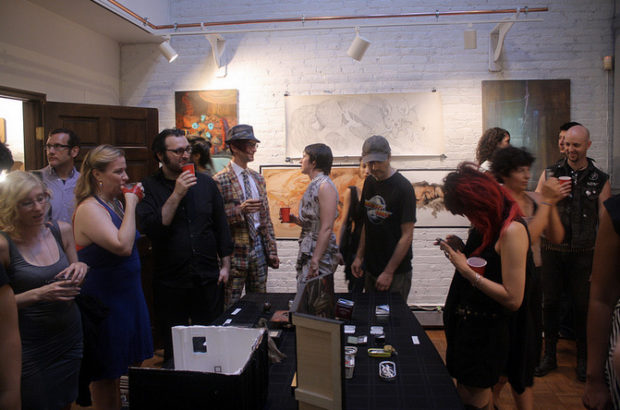
    The first Happening, which took place last August at Skylight Gallery in Chelsea, Manhattan’s famed art district, was a resounding success with a packed space. We are currently in the midst of organizing our second one, which will take place on Saturday September 13th at Gristle Tattoo in Bushwick, Brooklyn. If you will be in the area, please join us. Here is the Facebook Event Page.

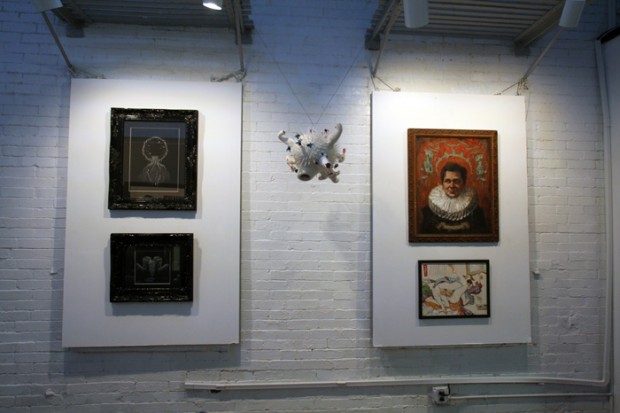
    TheHappening_YuriLeonov_2013_2

    I thought you might appreciate hearing from Allison directly:

    Samantha Levin for Creep Machine Magazine: What prompted you to start the salons?

    Allison Sommers: After a year or so of living in the city, I looked around and realized that I was friends with more artists than I had ever known in my life, and, furthermore, I respected their work and fed off their energy. I can’t remember what sparked the idea of starting the Salon exactly, but it grew out of this desire to see what happens when everyone gets together, shows work that noone else can see (in progress, not for public consumption) in a safe space, and mixes social life with art life until they’re indistinguishable. It’s a closed, intimate club where special things happen and joys and miseries alike are shared. Everyone sticks their neck out, and there is a power in being in art-cahoots like that. It’s a very old-fashioned sort of dream, a fin de siecle (part II) bohemian rejiggering.

    TheHappening_SamanthaLevin_2013_8

    SL: Why move to a bigger event with the happening?

    AS: It was quite organic– after a year or so of Salons, we all realized that we had something together, that there was a power to this unorganized collective that could be harnessed, or at least amplified. Having a public event also meant it was an event of inclusion, whereas the Salons are closed-door and finite (everyone must participate, and only so many can come, if nothing else but because my apartment is only so big). Very importantly, it’s an opportunity to engage in public displays of art without the confines of market or business concerns, something that comes up repeatedly as an irritant, the self-censorship and commodification of art object that plagues our ‘everyday’ work. The Happening is an art-verb for an evening, not a selling event, and it’s important to me that it remains dynamic.

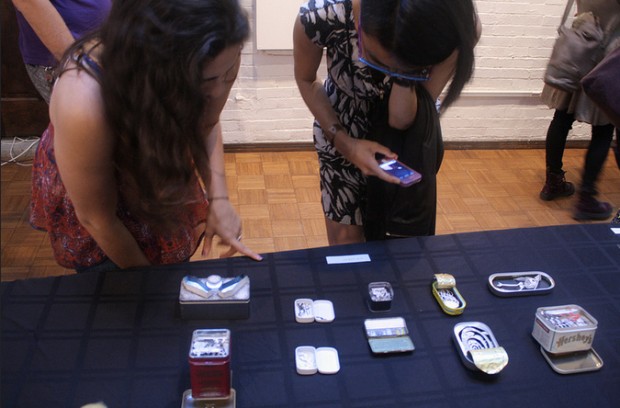
    TheHappening_YuriLeonov_2013_3

    SL: What are you hoping it will develop into?

    AS: Gerrit and I have long, feverish, arm-waving discussions about what we want to do in New York with art and artists. I think that we (and our Salon/Happening compatriots) are very frustrated with the art market and scene that we engage with on a regular basis, and I really think that it’s up to us to bludgeon our worlds into our liking. There are plans for more solidification of collective, more organization of art-political action, but only time will tell whether it’s pie in the sky thinking or merely ideas that are waiting to be actualized. It’s better when it’s a bit of both, I guess.

    Learn more about The Happening Here: http://thehappeningnyc.tumblr.com/

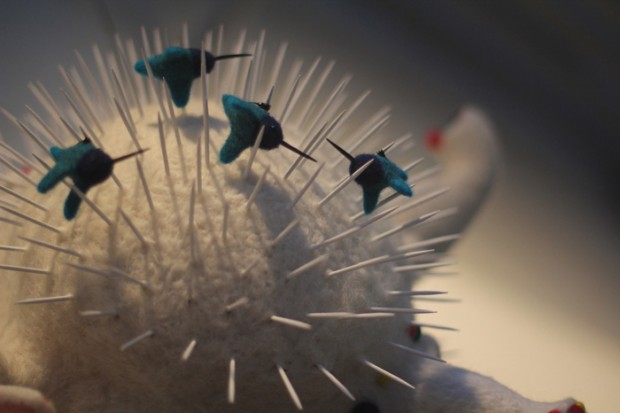
    TheHappening_2013_ZoeWilliams

    TheHappening_2013_AllisonSommers

  • Interview: Christopher Ulrich

    Interview: Christopher Ulrich

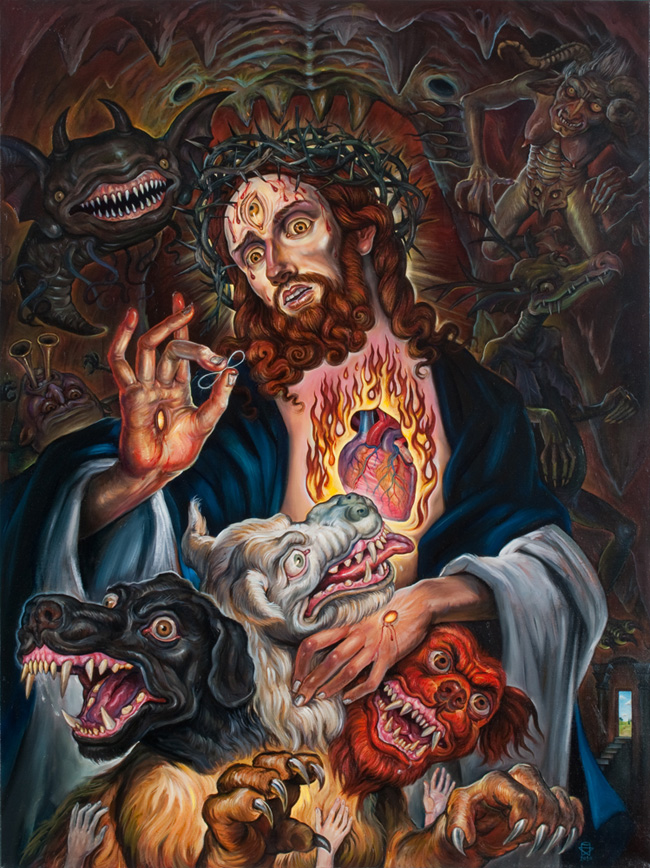
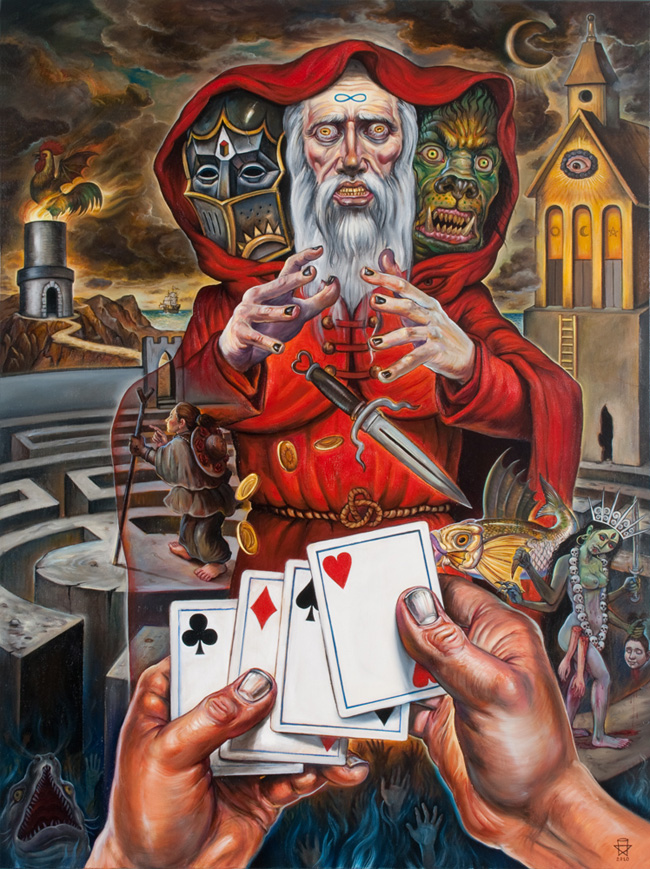
    Christopher Ulrich is an artist working out of Los Angeles, CA. His work is filled with surreal, iconographic imagery. Following his Demoneater, and Illuminator shows, Christopher will be opening his latest solo show at La Luz De Jesus, The Reckoning in December 2012.

    Ulrich_LG_Grace

    Creep: Can you tell us a bit about your history with art: how you got started, any formal education, and obstacles you encountered in your journey until now?

    Christopher: On my website I playfully illustrated a map of my life. It starts when I was born and leads up to my second series “Illuminator”. I keep regular journals, and encourage others to do the same. Overall I have found that my sketchbooks have been the most helpful tool, and promote a sense of adventure that is vital to life. The Masters have left behind their individual road maps, and each person marks their own way through the labyrinth of life. At the center is death, but along the way there are golden moments and opportunities, often disguised as obstacles. I believe that Art is a beautiful way of navigating through this maze. Just look at what others have left behind! I am still not entirely sure what all this means, to be an artist. I was not able to call myself an artist for a very long time. Now I am considered to be one. Perhaps when I reach the center, with my last breath, I will understand. Wouldn’t it be glorious to find out sooner! Alas there are no short cuts; I have tried a few with devastating results. Be true and clear. Investigate yourself. The rest will follow.

    Creep: Coming this December to La Luz De Jesus Gallery is your new show, “The Reckoning”. Can you tell us a bit about this new series of works?

    Christopher: On 12-7-12 I will have a show, which I am currently working on, titled “Christ Chronocrater – The Reckoning – Series 3”. It will feature 12 new works. My intent is the creation of something magical. It is an alchemic operation of faith from the perspective of doubt transformed. It is greater and stronger than I am and to speak of it is misleading. The “Reckoning” is not a final judgment; instead it implies a settling of all accounts. The whole body of work is based on the twelve operations. The series climaxes with the “Last Supper” which is located at the point where the serpent’s mouth swallows its tail. This series is the third and last chapter of a process I started in 2005, which I had the opportunity to show series 1 in 2007 on Day of the Dead. Demoneater began the process. It was the black. I then showed series 2 “Illuminator: The Royal Wedding” on August the sixth, 2010. It was the white. This last series will be the reddening, and for anyone who can come to see it on that night will be a part of something wondrous.

    Creep: You work with a variety of mediums. Are there any mediums you would like to work with in the future, such as sculpture, video, digital art or likewise?

    Christopher: What if you had an experience in which artwork was making you? For example, you see something unreal and it “talks” to you. This “thing” will only reveal itself to others if it is carved in wood. Suddenly you find yourself carving wood to find it. The wood mysteriously shapes itself into the form of the very thing that you have imagined communicating with. This is the relationship to the invisible world. I do have things I wish to express in stone, marble, wood, found objects, movies, masks, graphic novels and even toys! We shall see what happens!

    Ulrich_Fertility

    Creep: Can you tell us a bit about the visual language you developed over the years?

    Christopher: Over a period of time I have begun to feel that I am not developing anything, I am being developed by my art. You create a body of work. Then you are known for it, it defines you- whether you like it or not. Eventually you wonder: Why did I make it? Why does my work look like that? Why doesn’t it look like someone else’s work? Other artists may feel the same way. Do we choose what we make, and who we are? I cannot honestly answer this question. I have discovered that behind the visual language is a code. The code holds meaning and I hope it is as intriguing to the viewer as it is for me.

    Creep: After looking at the La Luz De Jesus website, and some of the shows you have had there, it shows you not only create concept sketches but also discovery works. Along with the phase of discovery and the steps leading towards the completed works, what are some of the other methods of inspiration you use, such as music, movies, etc?

    Christopher: The thing that moves me more than anything is a sincere moment. Truthfully, in this phase of painting “The Reckoning”, I find myself retreating to nature for inspiration. Quite frankly, I need to quiet my mind in this stage of my process. Our world is very loud, full of distraction and chaos. I am not insulated from it, and do not work in a vacuum. The suffering and noise can be overwhelming. Gossip is especially destructive, and our communications are impregnated with it. Long walks seem to help.

    Ulrich_Humility

  • Interview with Aaron Nagel

    Interview with Aaron Nagel

    Coming this Tuesday, January 10th is a co-curated print release from 1xrun and Creep Machine. The print entitled “The Calming” is by Aaron Nagel and is 14″ x 20″ on 140lb French Archival paper, signed and numbered in a max edition of 60. In lead up to the print release, Aaron was nice enough to answer some questions for a new, very in-depth interview here on the site. The image shown below is of the print that will be released tomorrow (right here) at 1xrun, and the rest of the interview features some random images from some of Aaron’s past shows.

    Creep Machine: Your a self taught artist, which is very impressive when looking at your work, but music was another path you might have taken. What was it that made you choose painting over music?

    Aaron Nagel: I spent years pursuing music and touring with bands, long before the idea of pursuing art as a career even occurred to me. With the bands…the idea of pursuing a career in music started to get in the way of playing music because we loved it. There was a point where we had been touring for so many years that we lacked the energy to keep at it at that level…without some degree of success. We could support ourselves on the road, but only long enough to live a couple months back home before we’d have to go out and make money again. That was fine when I was younger, but even by my mid twenties, the idea of touring for 6+ months out of the year started to become really undesirable. Plus, there were so many factors in whether or not a band “makes it”, that were entirely out of our control, which became really frustrating. Basically, at some point we realized that if we wanted to be in a band, that we would be in band, and we would function in that band exactly how we wanted to, without any consideration for the career aspect of it. That made playing music much more fulfilling, but removed it from the potential careers list. I was getting more serious about painting at the time the band thing was wrapping up, so I decided I’d try to make it my focus, at least for a while. It’s just as hard to make a living painting than it was playing music, but I feel like i’m much better at it, I have more control, and am entirely fulfilled in my career choice…regardless of how successful I am or will be. It’s a good feeling.

    Creep: You have stated before that you are an atheist, however your work draws inspiration from many classical, religious elements. Can you tell us what this iconography means to you, and how you have applied it to your style?

    Aaron: I’m not sure that iconography means anything to me. I think that’s one of the reasons I try and make my own; to create something that has the presence of iconography, the power and grandeur, while signifying something that I can actually relate to, that does actually mean something to me. The iconography that influences me is entirely visual, I love the imagery and in many cases, the artistry is unparalleled, but the stories and characters they portray mean nothing to me personally. It’s all nonsense…but very pretty nonsense.

    Creep: The female figure has always been a source of inspiration to artists which has given way to the idea of the “male gaze”, that the figure is an object placed there for the viewer. Yet the women in your work look powerful and strong, engaging the viewer. Can you tell us a bit about women in your paintings, who they symbolize.

    Aaron: I paint the women I do and pose them the way I do because I’m trying to convey power. I freely admit the power that some women have over me is significant, and to me, that power makes a perfect stand-in for god, or something else godly. The women aren’t posing for the viewer…or for me, i’m trying to get them to take on that power, and appear entirely unaffected by the audience, environment, etc.

    Creep: Many contemporary artists draw inspiration from pop culture, and infuse this imagery in their work. Yours is very classical in design. Who are some of the contemporary artists that you admire, and which ones have influenced the direction of your work and how?

    Aaron: I’m not a fan of pop-art and am not huge on pop-surrealism, so the contemporary artists I admire and that influence me don’t generally pull from pop culture either. as far as living artists go, I’m very much inspired by Alex Kanevsky, Kim Cogan, Micheal Hussar, Jenny Saville, Sean Cheetham, and tons more. They all inspire me to paint better, and each probably influence my painting in their own way that I’m not entirely conscious of. I certainly will sometimes try and paint more like this artist or that artist, generally in studies, just to see what works with where I am as a painter at that moment. It’s a great resource, and I would hope makes me a more versatile artist.

    Creep: You started using acrylics and moved on to oils. What is that you love about the medium, and what were some of the obstacles you needed to overcome to get to where you are now?

    Aaron: Oils just really work for me. I love how simple they are; pigment and oil, that’s it — but at the same time; the depth of color, the range of color, mediums, brands, surfaces, additives…it can get hugely complicated. But they can be controlled, and there’s hundreds and hundreds of years of examples as to what can be done with them. I love that potential, and that I confidently feel like I will always have a lot to learn about oil painting. I don’t think anything compares to a really well executed oil painting. As far as obstacles go, I’m constantly finding new ones and having to work through them, many of which will reoccur as I get more critical of my own work and as I improve. Generally I feel like my obstacles are technical, that I’m not rendering flesh accurately or over-working certain areas. I used to be very much intimidated by painting faces and hands and would focus on painting bodies. I’d add elements or compose the piece in a way to try and hide the areas I was afraid to paint. Painting figures, especially portraiture, requires a lot of confidence. Confidence at least so that you can make it to the point in a painting where things start to not look horrible. It took me quite a while to figure that out and I would stop myself, or ruin the piece long before it even had a chance of looking right. I’m constantly struggling with that balance; being confident enough in my execution to not shoot myself in the foot and stall, but critical enough to know that I could always have done better.

    Creep: I have always been interested in the process artists us to create work. For those of us that geek out on that, can you give us a short rundown of one your paintings from conception to completion?

    Aaron: The abbreviated version: I generally will go into a photo-shoot with some rough ideas, or I’ll come up with rough ideas and book a model that I think may work. The concept and mood of the painting is very much based on that shoot though, so collaboration with the model is a huge part of it. I usually shoot the model in my living room and then spend days and days going through the pictures. I’ll then do a digital comp of the image so I can figure out layout, canvas size, and if i’m going to add any additional elements to the piece that weren’t a part of the actual shoot. I’ll then sketch that comp onto the canvas, either straight up, with a grid system, or if the painting is giant, a combination of a grid and carbon transfer. i’m becoming less dependent on the sketch as I get more comfortable “sketching” with paint, so I’m gradually trying to do without it and go straight into painting. I’ll then tint the canvas, so I’m not working on a stark white surface and so that I will have some tone underneath the paint. Once all that prep is done, I actually start in with the painting. I always paint the face of my figure in that first sitting. I like working with wet paint and hate having to go back into a face to rework areas, so that first session is really important, and can last 8-14 hrs. Once the face is done, I’ll progressively move down the body, working from background to foreground. Hair and background is generally done at the same time I work the figure, in a manner at which I can keep as much of the paint wet as possible (this is to facilitate working on edges). Once I have a base layer of paint on the entire canvas, I’ll go back into everything with glazes until it looks right.

    Creep: Some listen to music, watch movies or talk radio, what is the environment like while you are painting?

    Aaron: I always listen to audiobooks. always. Ever since I was a kid, I’d listen to books on tape whenever drew or did anything creative. Still do. I get through quite a few.

    Creep: After writing about art for the past 5 years, I have noticed nudity in art is still something people stray away from and something many artists touch upon very rarely. It was something that was very common in classical art. What are your thoughts on the way nudity is seen in art, especially in the US.

    Aaron: Oh man, I could go on about this for hours. It’s insanely frustrating that there’s such a stigma attached with nudity. The fact that it has such a prominent place in art history just makes it more unbelievable that it’s such an issue today. People seem to be overly concerned about what others are doing, especially if it’s something they don’t understand. I can only attribute to good ‘ol American arrogance, and that so much of this country is stuck in this weird conservative thought vacuum, where evolution is a “theory” and the “family” needs protecting. Which is isn’t to say it’s the right that’s screwing things up, I’ve seen some pretty serious arguments about my own work between women on message boards…addressing whether or not i’m a chauvinist and painting sex objects, or whether i’m painting the female form because it’s beautiful. I’d hazard to guess both sides of that argument identified as left-leaning feminists. I appreciate that there is a dialogue, and everybody is entitled to their opinion…but sometimes I wish people would take care of their own shit. I was just recently banned from Facebook for 24hrs because somebody took offense to a painting of mine. It’s so nuts that it’s hard to get really angry — these people are so far from rational thought, who has time talk sense into them? The irony is that I’m actively engaging in heresy, and I haven’t had a single religious person on my back about it…they all get caught up on the nudity.

    Creep: Your latest print, entitled “The Calming”, is a limited edition being co-released by 1xrun and Creep Machine. Can you tell us a bit more about this image and the creation of it?

    The concept behind “the Calming” was a long time coming. I’d been painting my models hands for a while but had always wanted to experiment with conveying some sort of vaguely religious symbolism with that paint. Logistically, I had to wait until the right time to attempt it though. It required a model willing to let me paint her torso with quite a bit of black paint, and the composition felt like it needed a really big canvas to work. I finally got into it in November of 2010, and while larger paintings usually take me really long, this one went relatively quickly. I think start to finish was about a month, and considering it’s almost 5′ tall, was pretty quick for me. Most paintings don’t go as smoothly, but I think the concept just really worked and I had a really clear idea of what I wanted it to look like the whole time. The model is my friend Nikki, who I had painted 5 or 6 times already when I started working on this one, so we work really well together. She’s a fantastic model and unlike many I’ve worked with, is totally into the art of it. It’s still one of my favorite pieces.

    Creep: What are some of the projects your have prepared for 2012, and any secret info you don’t mind sharing?

    Aaron: Actually, at the moment I have very little planned. I’m sure I’ll be doing some group shows here and there, but I don’t plan on starting to work towards another solo for a while. I did a lot last year — something like 22 paintings in total, and I really feel like I need some time to practice, work on some new ideas, and get better. Right now, I plan to just work on quick studies, and experiments, and will probably be back with another solo show early 2013. Keep an eye on my blog though, I’ll be posting my studies as I go.

    Thanks Aaron. I’ll be watching the blog for sure, and if you haven’t done so already head on over and subscribe to his feed and newsletter for all upcoming news and events. AaronNagel.com

    Also, make sure you check out 1xrun this January 10th if you are interested in this print. The quality from 1xrun is amazing, and I have a feeling this print will go fast. 1xrun.com
  • The Mechanics of Christopher Conte

    The Mechanics of Christopher Conte

    Christopher Conte’s artwork is full of surprises. While many of the elements in his sculptures are machined, cast or carved by him, he also incorporates parts of familiar machinery that, if you’re paying close enough attention, you will recognize. Antique watch movements, sewing machine feet and other old cogs and gears give his sculptures a retro steampunk flavor, while other elements like iPod cameras push his work into the future evoking some of the greatest of scifi stories.

    Dermabot (Skin Crawler) steel, bronze, and brass with working onboard miniature tattoo machine

    Christopher’s sculptures indeed capture the attention of a steampunk audience, but also the Transhumanist movement, which revels in the power of biomechanics for promoting human advancement and explores the dangers that such enhancements might cause, has taken a great liking to his work. Wired Magazine, a publication which has some of its tentacles entwined in the movement, has published multiple interviews and articles on him, and many Maker Faire enthusiasts, scientists and medical professionals who support it collect his work.
    (more…)

  • Interview: Paul Komoda – The Thing Comes to Life

    Interview: Paul Komoda – The Thing Comes to Life

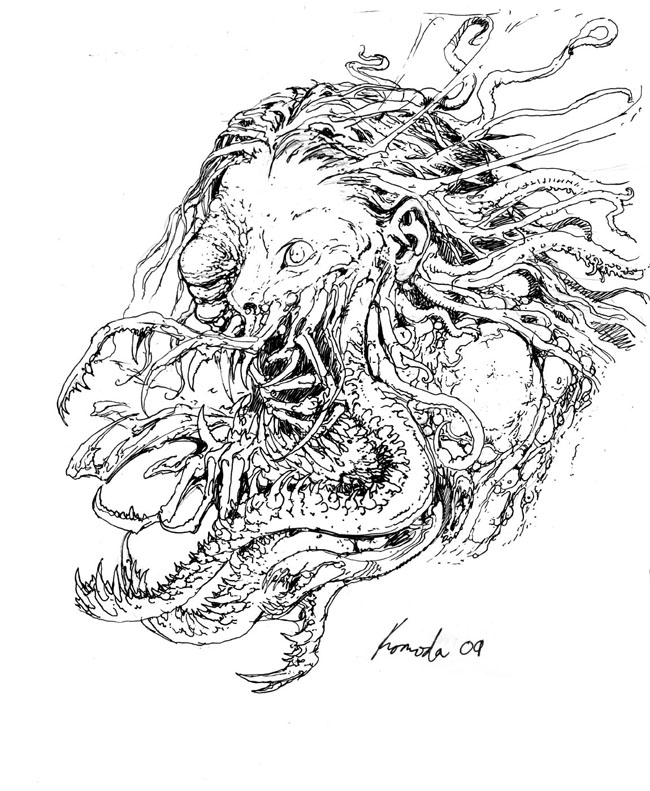
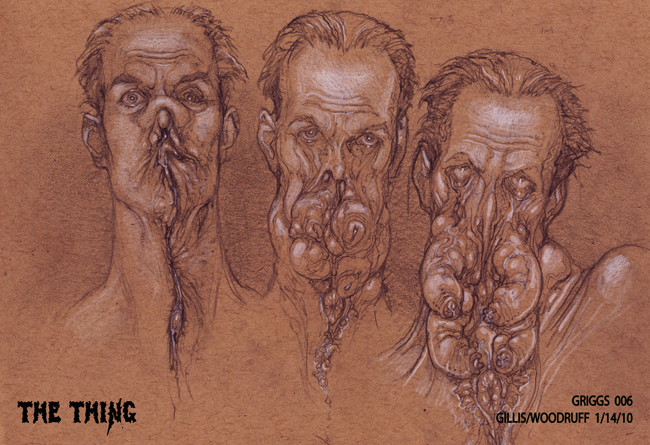
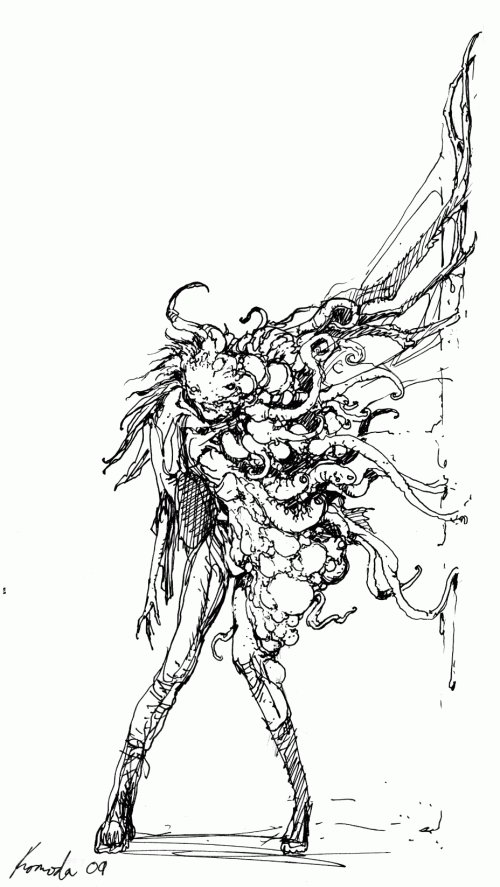
    Over the past year, artist Paul Komoda has been dropping hints of his involvement in a new movie.  Turns out that movie is The Thing, a prequel to the famous Carpenter film that gave me nightmares for the majority of my childhood.  Since its recent release, Paul has finally been able to show to the world the creature creation drawings he did for it as well as some of the sculptures he and the crew worked on.

    Paul is most definitely one of my favorite artists today.  His imagination for monsters is hard to describe – they are beautiful creatures, either benign or horrific, that move on the pages on which they were drawn.  It goes without saying that I was excited to find out what The Thing looked like before it hit the big screen where much of Paul’s designs had been animated into CG.  This is really a perfect platform for Paul’s imagination.  I excitedly contacted the artist to find out what goodies he had to offer to the blogosphere.

    Samantha Levin: How did this come about?

    Paul Komoda: I was called by my friend, the renown creature designer, Jordu Schell (now seen on the Travel Channel show “Making Monsters“) when the studio [Amalgamated Dynamics Inc., founded by Alec Gillis and Tom Woodruff] was bidding on the job. He was called in as a creature designer and recommended me to Alec Gillis, who consequently called me about coming up with a few drawings to help create a presentation.  Alec and Tom really responded to the work in my sketchbook, and really wanted me to incorporate the organic translucency I imbue my drawings with, into the concept art for the various shape-shifting apparitions.  The way it goes is that a film will be announced as going into production, and several special effects studios will vie for the job, presenting sculptures and/or illustrations relating to the project in question.  I was in New Jersey visiting my family at the time, with a only a few days until the New Year, so I wound up staying up late nights in the same basement I used to work in when I lived there, kicking out designs.  A week after I’d returned to LA, I got a call from Alec at ADI, telling me that we had the film.  I spent the first few weeks at the studio, doing drawings, and small concept sculptures. Eventually I moved on to sculpt some of the full-scale creatures.  It was an amazing time!


    SL: I’m sure!  It seems to have given you a chance to express yourself quite freely for this, at least during the initial concept phase.

    PK: I suppose I should say that outside of my personal work, I’m mostly known for being a commercial sculptor, which for better or worse, is more of a technical thing, if anything.  When I was brought on to the film, it was really an opportunity to just do what I do best, which is the more visceral body-horror themed work, and the creatures, the biological/ zoological side of things.

    SL: What are you working on now?

    PK:  I’m currently doing sculpture and design for Sideshow Collectibles, as well as continuing with my own artwork, the sculptural aspect being made available through Artist Proof Studio.  Also, I’m preparing to do some body-paint designs for a new Android Lust video directed by Dan Ouellette.  Plans are afoot to collaborate with Mother of London on some clothing incorporating my imagery.  Lastly, I’m working on getting my sketchbook into a published form, before it becomes the longest running joke of my life [Paul and supporters have made numerous attempts to get his sketchbook published over the past 10 plus years -ed].

    The team of artists who worked with Paul on the monster included ADI founders Alec Gillis and Tom Woodruff as well as Jordu Schell, Miyo Nakamura, Casey Love, Mikey Rotella and a small army of people working on props and other creatures.  Paul told me that very little of the work they did shows up in the movie although, “on the brighter side, a few of my designs survived intact.”  No matter; it’s the artwork we want to see on this blog.  I’m agape from all the upcoming projects Paul has listed – some of my favorite artists are listed in that last paragraph.  Can’t wait to hear more!

    By the way, Jordu Schell posts a daily “Monster of the Day” on his blog.  It’s pretty cool and kinda silly.  Go check it out.


  • Interview: Paul Chatem

    Interview: Paul Chatem

    Back in May I reviewed Paul Chatem’s latest solo show “Island of the Colorblind”, and ever since then I had the plan to interview Paul and get a deeper look into his working process, what inspires him, and how he deal with being colorblind. Of course it took a lot longer than I thought to get this interview going, but luckily for me Samantha Levin came to rescue and helped out with the interview, coming up with some great questions and acquiring the images you see below. So this is the very first dual-interview here on the Creep Machine, and I think it worked out very well. Perhaps we will see more in the future. Make sure to click the “read more” for the full interview.

    Creep: In order to create this latest series of interactive works, you learned an entirely new skill: clock making. This has given your works an extremely unique element to them, and added audience participation. Did you have any other ideas to create interactivity aside from the clock style works of art?

    Paul Chatem: I’ve read a bit about clock making as well as gear ratios. Clock making is more complicated than what I’m doing. I’m just using the basics of gears or cogs to create a kinetic aspect to my paintings. At this point the movement in the gears has been pretty simple, there’s still a lot of things I need to learn so I can take it to the next level.
    (more…)

  • Interview: Peter Adamyan

    Interview: Peter Adamyan

    During the reception at Peter Adamyan’s solo show at the Lopo Gallery (reviewed), I talked to him about doing an interview for the site. It took a bit longer than anticipated, but here it is. I wanted to get a better insight to this artists work, and I hope this interview does that.

    Creep: You stated that you have been drawing since you were very young, did you have any formal art education? If not what was it that helped with the current set of skills you have now?

    Peter: For the most part I’m self taught. My brother was my first big influence, he taught me how to make up my own cartoon characters by created a chart of different features I could mix and match. We used to watch Imagination Station with Mark Kistler on PBS which is how I first learned basics like perspective and value. When we weren’t watching that we were drawing Spiderman, Spawn and X-Men out of comics and The Simpsons off the television. In high school I took the usual art classes that everyone who’s interested in art takes to fill up their elective classes and through that I got a scholarship with the Ryman program where I first drew from a live model. But most of what I know comes from reading books and doing research on the internet and just from loads of practice particularly when it comes to painting which I’ve never been formally trained in.

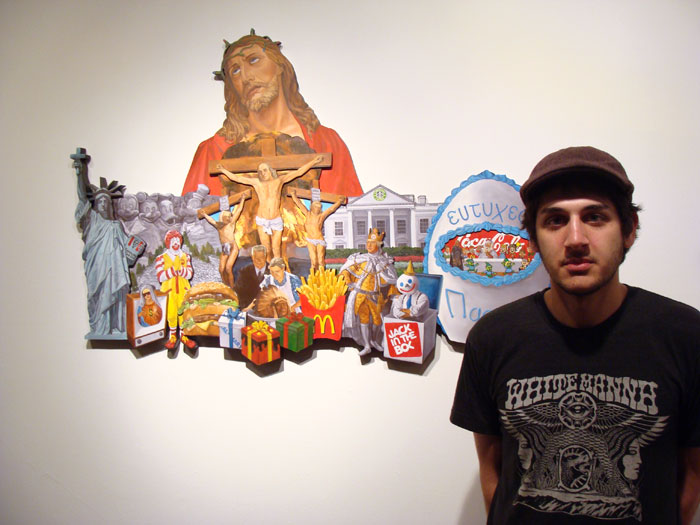
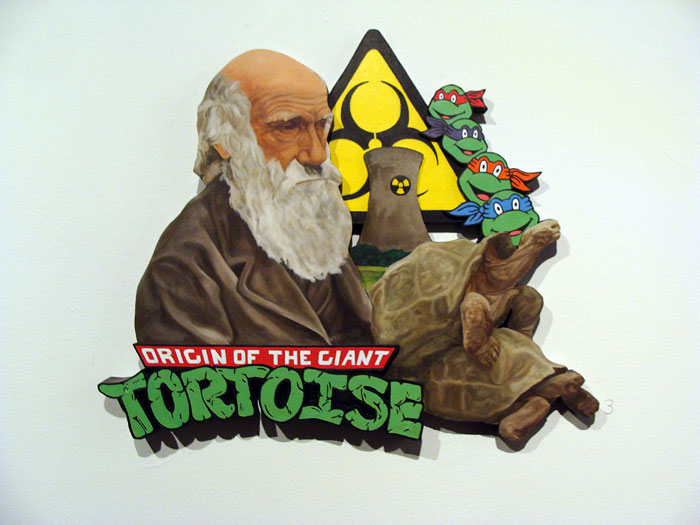
    Creep: One of the first things that caught my eye about your art, was the cutout pieces of wood, and layers that you build with them. Pictures don’t show this very well, but one painting could easily be 3-5 layers deep. What was it that inspired this layered style?

    Peter: When I first started making art seriously I wanted to be able to work with any medium, so I started doing the cut out to be able to experiment with different mediums while still being a painter with a consistent style. Eventually the painting aspect became more important. At the same time I enjoyed cutting out the pieces and having a collage look as well as not having my work stuck inside of a rectangular composition, I wanted the paintings to take their own shape and it didn’t seem to make sense if it were just a one layer cut out.

    Creep: Since your work is 3-dimensional in a way, will fans one day see your work getting even more sculptural? I can only image how amazing a full body sculpture of some of the scenes you have created would be.

    Peter: The largest piece in my latest show at Lopo Gallery took about 400 hours of work and is the most complex piece to date and I’d love to do more like it and maybe even do more insulation based work in the future but every piece will be as elaborate as it needs to be and I will continue to push myself, we’ll see where it leads.

    Creep: Most of the works that I have seen from you, whether or not they are on wood or paper, almost always have color in them. Nothing that could be considered a drawing or sketch. Do you carry a sketchbook, or something to capture the ideas you want to work on?

    Peter: My sketch book isn’t to me what it is for other artists, it’s more of a tool to work out my composition, the ideas are mostly worked out in my head beforehand. I write down all my ideas for paintings in a separate book as I have more ideas then I have time. When time comes to work on them I usually have a pretty clear picture of what I want and use my sketch book to fit it all together in a cohesive way.

    Creep: Speaking of these ideas, some of the paintings have the most unique connections in them, The Incredible Hulk with a Gap logo, not to ruin the magic, but what process do you use to come to these connections?

    Peter: Like every artist I get ideas from many sources, sometimes it’s a message or belief I want to convey, sometimes it’s just a connection I thought was funny and other times it’s just something I want to do for fun like my portrait of Walt Disney. I usually have a bunch of ideas I want to put into the painting, lots of different details, as the idea develops and I work out the composition I usually have to drop a few ideas to make the piece work. In the Hulk piece you’re speaking of it originally started as an idea for a painting with Richard Simmons and The Incredible Hulk sharing the power of purple shorts, but it was eventually simplified to Green And Proud.

    Creep: Your work is filled with religious, political, and pop culture references. Pop culture as you have stated before is “our Gods and our fables”, and a common theme with lowbrow artists. However, politics and religion are themes that many artists tend to stray from. What continues to drive you forward with these themes, when you could easily be painting “cute” or tame images as many have stated the scene has now headed toward?

    Peter: I wouldn’t be able to live with myself if I painted cute imagery. Most of today’s so called Low Brow artists are better off as decorators for nurseries and play schools. I think it’s a sad turn for the movement to go in. The cute imagery started off being cute only on the surface and as you looked closer you would see a twisted humor but now the big eyed painters and home decorators have taken over. I’ve always believed art should be more then just decoration, it should be a form of entertainment and a way of sharing ideas. At the least it should make you think or make you laugh, or both. Ideas are what make me want to make art and those ideas are inspired by my beliefs. Not all my work is political like the work from my most recent show but I used the show as a way to vent a lot of my frustrations with society.

    Creep: Who are some of the artists that were instrumental in the way your work has come about, and what artists continue to inspire you today.

    Peter: Like I’ve said before I started off drawing cartoons and comic books which were my first influences. I went through high school studying the masters of art history and in the end of high school I came across the work of Britt Ehringer who inspired me with his use of photo-realism and collaged compositions. Later I came across the work of Micah Sherrill who inspired my experimentation with different mediums and unusual materials. I continued to find inspiration in my love of illustrations from B-movies and pulp magazines and of course the original Low Brow artists like Robert Williams, Joe Coleman, S. Clay Wilson and R. Crumb who have taught me to not hold anything back, even if it makes me feel uncomfortable.

    Creep: When I first met you it was at your Lopo Gallery show. One of the things I enjoyed was the reaction that many of the patrons had about your work. Can you tell us a bit of the way people have reacted to your work, any extreme situations?

    Peter: Nothing extreme as of yet, for the most part I’ve only heard loud laughter. My first solo show at the Hyaena Gallery was inspired by serial killers and other evil men and it had a lot of people who didn’t know me well asking “is this what’s in your head” whatever that means. The only negative response I’ve received so far has been from cowardly curators who are afraid I may scare off their collectors.

    Creep: Are there any pop culture references that you would not integrate into your work?

    Peter: There has been a few times where I’ve told myself, “Maybe I shouldn’t do this?” such as in my Aladdin painting, but I tell myself that?s exactly why I have to go through with it. The only line I have not been willing to cross, and don’t find myself likely to cross is making fun of human suffering caused by natural disasters, but I have no problem making fun of people who cause the suffering of others and I use any pop culture reference I see fit for doing so because as I’ve said in other interviews, I try to use our popular culture as symbolism for the greater message.

    Creep: Finally, can you give us an idea of what new series or imagery you are working on for future shows?

    Peter: Right now I’m just working on a few pieces for group shows and working on a series of head cut outs I’ve been wanting to do for a while. I have multiple ideas for shows with long lists of painting ideas for each but I won’t give much away. I’m always working on something, I really don’t have a choice in the matter, like most artists making art is a habit that I couldn’t break if I wanted to.

    Thanks to Peter for taking the time to answer these questions. If you haven’t already, make sure to check out his homepage for more work and news.
    Peteradamyan.com

  • Interview: Crystal Barbre

    Interview: Crystal Barbre

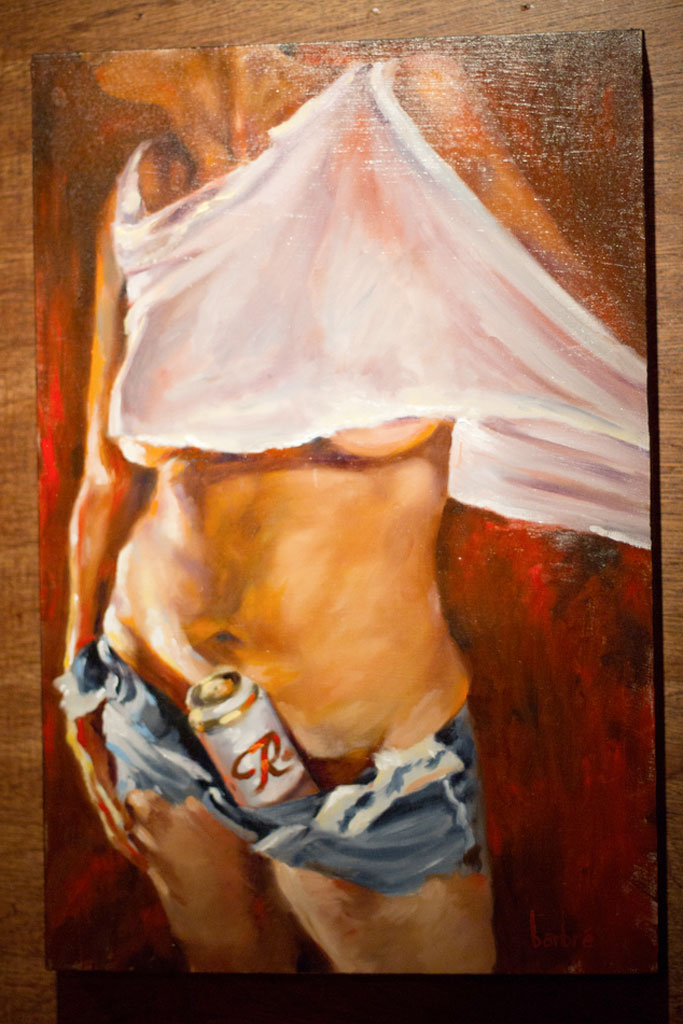
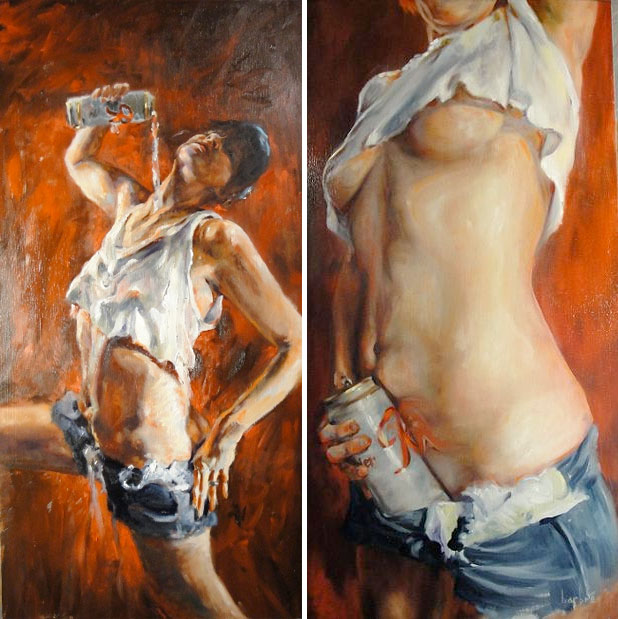
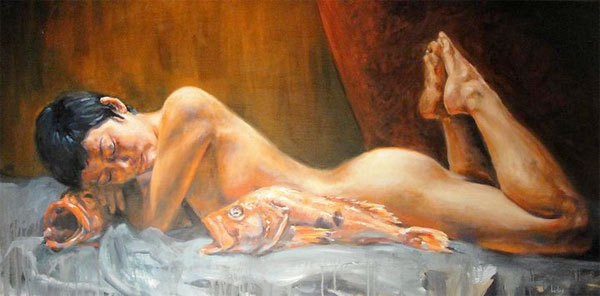
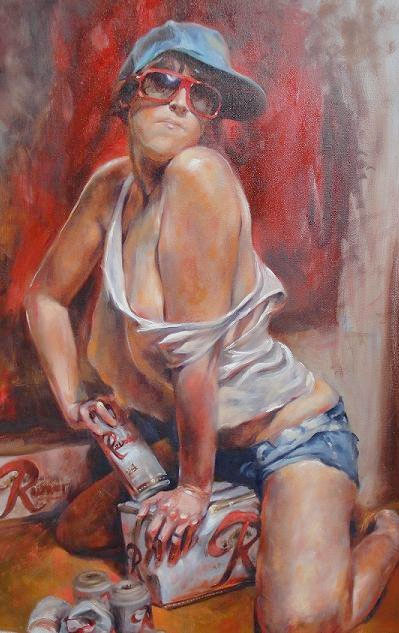
    It’s been little under a week since Seattle based Crystal Barbre opened her latest solo exhibition at the Whisky Bar in her hometown. The show features some new figurative works, and still life works. I sent some questions to Crystal a bit before the show and now that she has had some time to mellow out after the reception, she sent over what is sure to be the most in-depth interview the site has had. Greg Hanefeld has some excellent photos of the opening that you can view on his Flickr (here), you will also see a couple throughout this interview.

    crystalbarbre.jpg

    Creep: You attended the Mark Kang O’Higgins atelier at the Gage Academy of Art, which focuses on drawing and painting. Can you tell us a bit about your experience there, and what drew you to the program?

    Crystal: I had been interested in attending art school for a couple years. I checked out all the bigger name art institutions and even went and visited a few of them, but they seemed confused about my focus – wanting to learn the ins and outs of classical figurative painting but wanting to apply it to more “lowbrow” conceptual art which they considered illustration. They couldn’t seem to really understand combining the two – fine art and illustration. Then I found Mark’s atelier at the Gage Academy in Seattle. It’s so small I had my doubts at first but I am sure in two years I got one of the best educations I could get anywhere in the country. The atelier focuses hardcore on classical figurative drawing and painting skills while also allowing me to explore my work conceptually. The workload of painting 10 hours a day five or six days a week really is what gave me the ability to take my work to the next level professionally. I will always consider myself indebted to that program.

    choicest_crystalbarbre.jpg

    Creep: Is art something you have always created, drawing since you were a kid kind of story, or did you start later in life?

    Crystal: I lived out in the wilds of Eastern Washington when I was a kid. We didn’t have any running water or electricity for the first 14 years of my life. I was living in a fundamentalist Christian/hippie/farmstead environment. When I was a teenager we moved to the Seattle area and I just started drawing. It had been a pretty isolated, crazy existence up to that point so I think I got drawn into art as a way to help me exorcise some demons. As a teenager I couldn’t really express some of the things I had gone through at a young age and art gave me the vehicle to do that in a creative and nondestructive way. Even in college I fought the idea of being an artist but it was becoming a bigger and bigger part of my life. Finally in the last few years I’ve just jumped in and decided I have no choice but to focus on it completely.

    Creep: I know you are interested in classical art, who are some of your biggest influences? The artists that still amaze you every time your see their work?

    Crystal: There are so many classical artists whose influence I am completely indebted to. But some whose work consistently holds me in awe are Titian, Rubens, Rembrandt, Michelangelo, Vermeer, Diego Velázquez, Artemisia Gentileschi, and John Singer Sargent. Gentileschi especially has influenced my work, not only because of her paintings, but through the inspiration of her struggle to create a life for herself as a woman painter in the early 1600s.

    girls_crystalbarbre.jpg

    Creep: Just for giggles, what classical artist would you like to apprentice under?

    Crystal: Maybe this is cheating since neither of these people is dead, but they are both artists I studied in my classical training. It would have to be either Jenny Saville or Odd Nerdrum. I guess I’d go with Michelangelo in a pinch though.

    Creep: Looking through your previous work, you not only created drawings but collages as well. Your focus now seems to be strictly on paintings. Will we see some purely graphite or collage work in the future?

    Crystal: I still love doing drawings, though I’ve gone from using graphite to using charcoal which is much more versatile. The process of drawing is absolutely painstaking compared to painting, as well as the fact it is very hard to sell a drawing for the same price as a painting, even if there is as much work or more that has gone into it. I expect to do some more drawings in the future though probably more for myself personally than as any attempt to sell them. It is a great way to build technical skill and I enjoy the look of the finished result. Drawings can allow people to fill in the blanks more then in a painting, which can give drawings an air of mystery that a painting doesn’t have. The collage work is something I now use purely and crudely in my process of creating a finished painting. Though I have seen some amazing collage work from people such as Wangechi Mutu, it seems that collage as a medium has a hard time being taken seriously.

    Creep: Being trained at an atelier, along with your interest in classical art, i would be very interested in a rundown of your working process? 

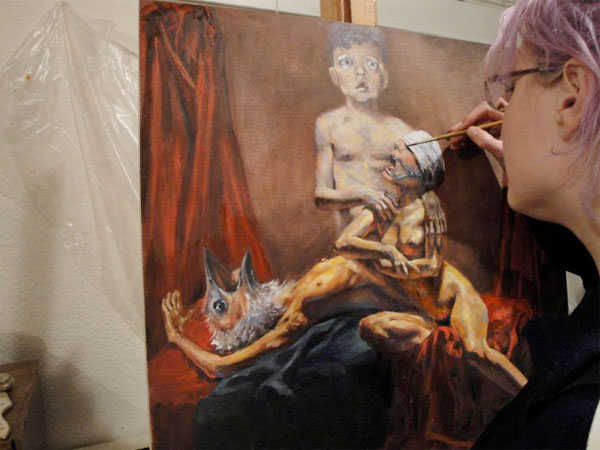
    Crystal: The preparation for a painting usually takes as long, if not longer than the time to make a painting itself. First is deciding on the concept which can take months of gathering resource material and doing research on different topics. Many of the paintings I do have their own symbolic language that I have spent weeks or months researching and constructing. Once I have pulled my reference photos from various sources and sketched out the basic idea for the piece I set up a photo session with models and props to be able beef up the found images with a set up that has the appropriate lighting, color, and perspective. This is where the collage work still comes into play – often, if the piece has complicated surreal imagery I have to do some collaging of different sources and try to bring the images together on the fly while I’m painting. I will usually sketch out the piece in more detail once I have all the references I need. If the painting is large I blow up the sketch and transfer it to the canvas. From there I sometimes do a burnt umber/raw umber under-painting to get a sense of value. After doing some color studies to find the palette I want to work with – I just dive in from there.

    jonah_crystalbarbre.jpg

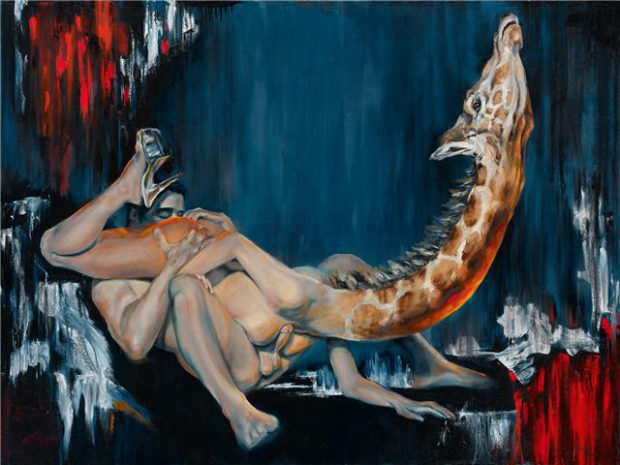
    Creep: You have already created a few series of works, the common thread being that they are figurative and often contain animals. Can you tell us a bit about the imagery in your work, and how it developed?

    Crystal: When I was growing up I didn’t go to school and we lived in a completely isolated environment in the wilderness. While most kids had other kids to hang out with growing up I only had my younger brothers and the animals that lived on our property. Having a close relationship with the deer, birds, cats, insects, chickens, and other animals instilled in me the connection between the human world and the animal world. Living off the land, sometimes you have to watch animals die, and I think these were particularly significant events for me. I also witnessed events that were far from the normal life cycle of animals, such as cats having their heads cut off or baked alive in the oven, which left an indelible imprint on me to always watch out for those living creatures that couldn’t protect themselves. I think it is natural for human beings to feel a connection to animals, especially when we are younger. Having animals as my primary source of companionship while I was growing up kept that connection from fading in me as I got older. Animals will now always have a very strong symbolism for me and will always be prevalent in my work. There is the personal aspect to the meaning of them in my own life, but as my work has matured I use animals as a symbol, not only for me and my past, but as symbols that connect me to my viewer – we all have connections between aspects of ourselves and those that animals embody. Societies have uses animals as symbols for thousands of years, to represent themselves and the world around them. I think it is easier to use animals than people to connect to those that view my paintings. People can see themselves in an animal easier then they can see themselves in another human face. As well, people can identify the emotion in a piece immediately when they see an animal – they are universal symbols for emotion – the courage of a lion, the bravery of an eagle, the innocence of a lamb – these are symbols that allow me to make an emotional shortcut with my viewer and to play with the aspects those animals represent.

    giraffa_crystalbarbre.jpg

    Creep: Your series “Magnetisme Animal” is no doubt the most shocking in your gallery, sex in art seems to be the one topic that is always difficult for the average viewer to appreciate. The work debuted at the Hyaena Gallery, can you tell us a bit about how you went about the inspiration for a few of the works as well as the art was received at the reception?

    Crystal: I’ve spent about three years working in porn shops, off and on, and I think the idea for these pieces comes from some of the lessons I learned working in that industry. The porn industry is FULL of strong, intelligent, independent women who have taken their careers in their own hands and have created very successful businesses for themselves. I found it to be one of the most empowering atmospheres I have ever had the chance to experience, while at the same time there is always this beast that exists which is that yes, there is a debasement of women going on and some operations aren’t exactly woman friendly . There are women that are taken advantage of and there are attitudes that are perpetuated in porn that are not necessarily healthy for women. There was a constant dialogue going on in my own mind, as well as with the other people I worked with in the industry, about this very concept. Porn, and sex in general, is a complicated issue. These paintings were a way of expressing that and also to generate a dialogue with people outside of that industry. I wanted to see what people would have to say about some of these issues that I had been thinking of for years. What really surprised me was how violent the opposition was to this series. I realize my tolerance level is a bit higher than many people’s. However, sex is a part of daily life, and I was very surprised to find out how many people were offended by these paintings.
    Many people didn’t realize that a woman painted these – when they met me the attitude would change and I had some very open and interesting conversations with people that had been offended before but on finding out I was a woman were more willing to engage in a dialogue about the meaning of the work. One of the most important aspects of these paintings is that in every piece the woman is in a position of sexual power in the relationship. The women are on top, or receiving oral sex, or generally enjoying themselves and taking control of their sexual experience. And believe it or not, I find that this is the thing that disturbs most people and seems to take the painting from sexy to pornographic. I find it funny that porn has existed in painting since the invention of painting itself. In classical painting it is completely acceptable to show a woman as an object of sex – lounging naked and willing, inviting the viewer to experience her body – or even more disturbingly, many images of naked women in the throes of a rape experience – but to show women in positions of power in which THEY are controlling the experience – the piece turns into being pornographic. Interesting, is all I have to say about THAT.
    On another note, though there was the occasional visitor to Hyaena that found the work offensive for one reason or another, the response at the opening was overwhelmingly positive. Hyaena is one of those special environments that attracts a kind of person that I think is able to experience images of sex and violence with a more open mind than your average person. That is one of the reasons I find Hyaena and its patrons such an inspiring place to be involved in.

    rainiergirl_crystalbarbre.jpg

    Creep: You had mentioned in your blog that you would like to attend the New York Academy of Art for your MFA. I like the idea that you wish to continue your education. What is it about this school that attracted you, and why not attend another Atelier, something that would be much cheaper in this economy. 

    Crystal: I think there are probably a good handful of places that I could continue my art education and receive a technical education of equal quality. However, the reason I am so set on the New York Academy of Art is that I think I have reached a point in my career in which I need to gain experience, not just in technical skill, but in learning how to make professional connections and establish a business in the art world. New York Academy is a place that I can make connections with some of the people I admire most in the world of art and I’m not sure I could find this anywhere else. At the same time, I’m not willing to leave grad school with a six figure debt, so if I am not able to figure out a way to pay my way through school without taking out massive loans, despite my desire for an education there, I’ll consider it a sign from the universe that I need to find another pathway to my goals. If I’ve learned anything in the few years I’ve been focusing on being a painter its that there’s more than one way to skin a cat (not literally, by the way – my paintings are a bit off but I’m not that much of a sicko).

    Creep: Finally, what are some of your other interests beside painting, something that you might try to make a career out of had you not went the direction of fine art?

    Crystal: I like this question! It took me quite a while before I realized painting had its hooks in me and would never let me go. I actually went to school for International Relations. I wanted to work for the UN and travel to war torn countries and do whatever I could to ease the suffering I might find there. Then I went to India, got kidnapped in Kashmir, and realized there was a very distinct possibility I was going to either be killed or sold into the sex slave trade. I had ten days of being held in a room with armed guards out front and fighting off advances from my captors in the evenings – to reconsider that career path. After writing my will, and then finally getting myself smuggled back to the Delhi airport, I flew home and decided it was best I find some other way to make my way in the world. In the years after that I was trained in lighting design for rock shows and toyed with the idea of making that a career path. It was very tempting! Compared to the hours of isolation in the studio it takes to make a good painting, making hundreds of people dance to band with a bunch of lasers and a fog machine is pretty instant gratification. It would have been fun to go on tour, and I enjoyed being one of the few women in the biz. But I just couldn’t get away from painting, and if you have your hand in too many things your art will always be half-assed. So I dropped it and took to painting full time.

    Thanks to Crystal for taking to time to give us such killer answers. Make sure you head over to her website to see more work.
    Crystal Barbre Portfolio