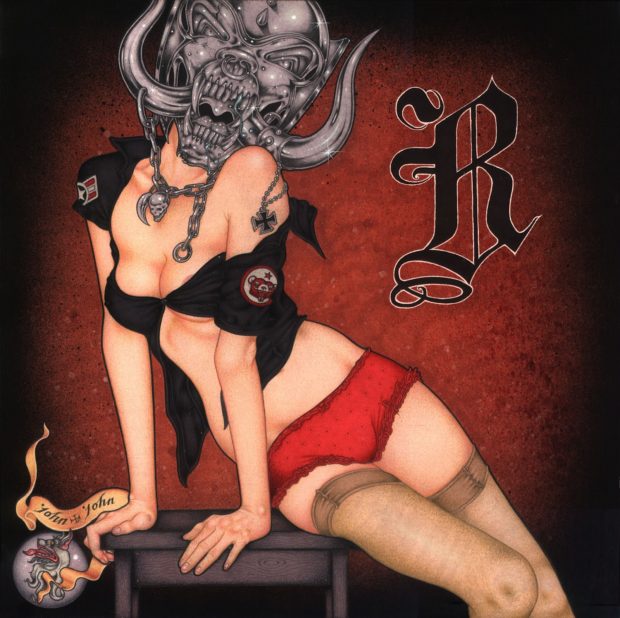
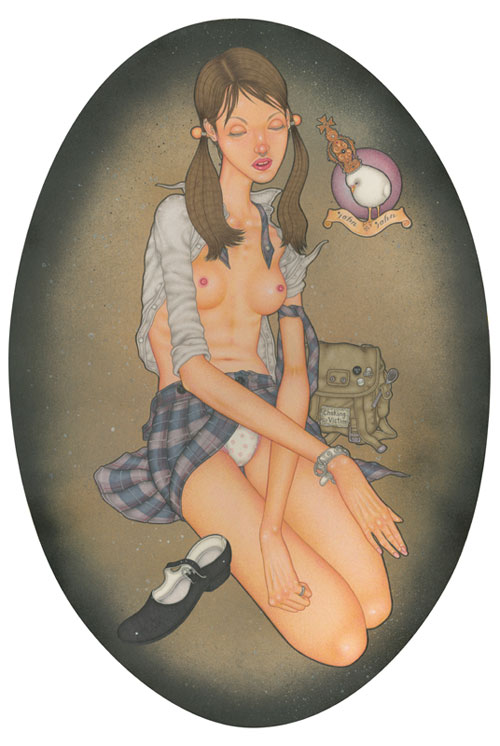
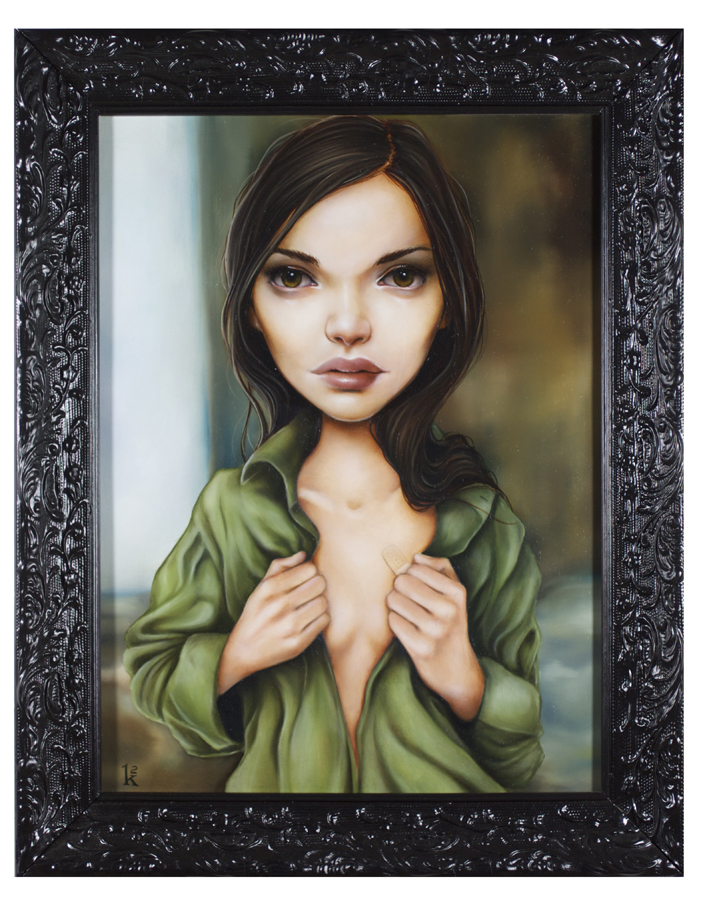
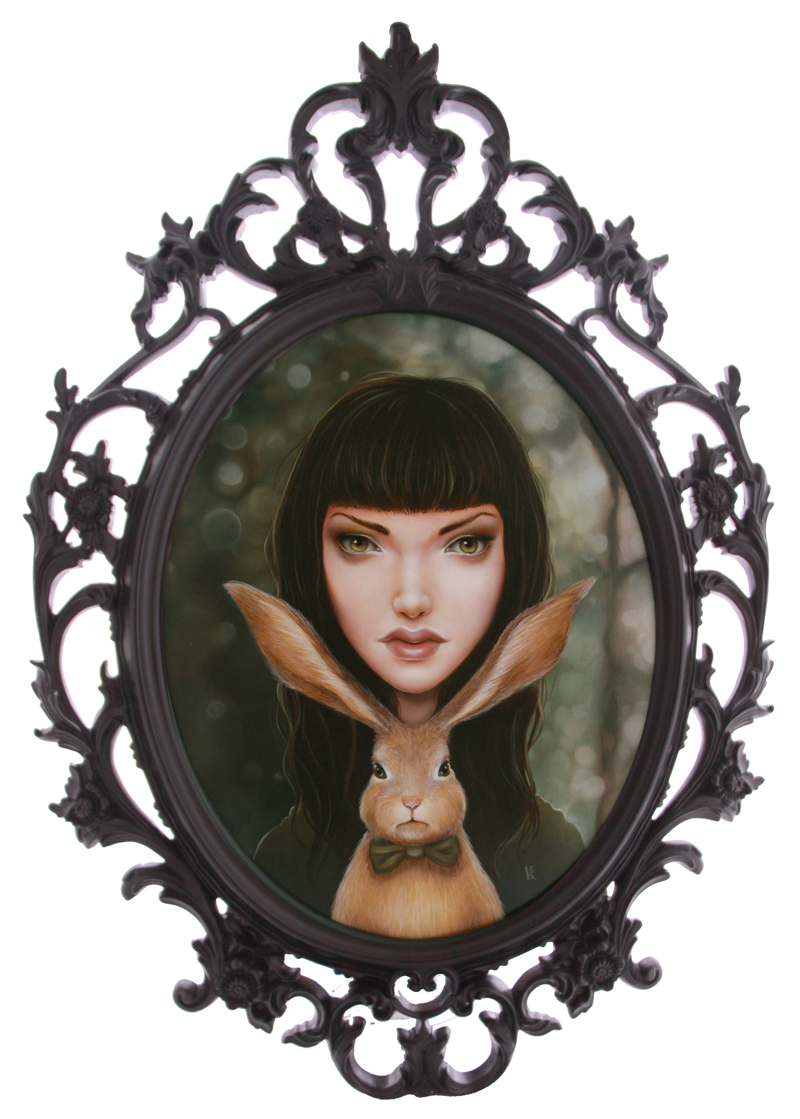
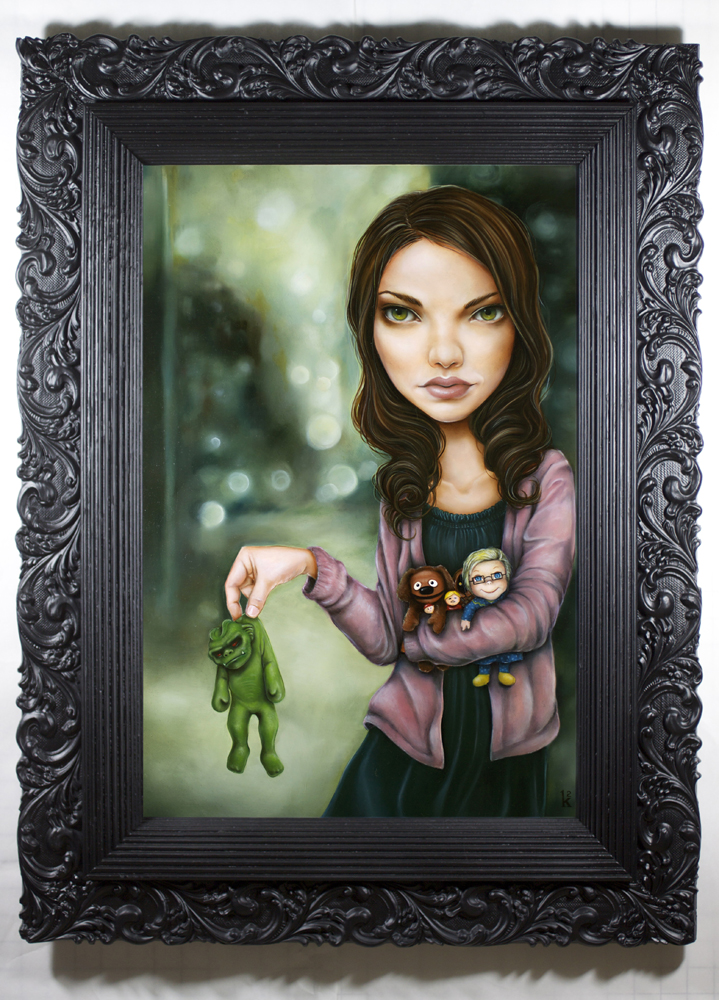
John-John Jesse opened his latest solo show at the Opera Gallery this past April 16th, his first solo show in years. I worked up a few questions and was able to get John-John for an interview when he came back from the reception.
Creep: You have stated that among your favorite artists is Caravaggio, a favorite of mine as well. Can you tell me a bit about what first drew you to his work, and if there is any influence he has had on your style?
John-John: Its just soo dark and beautiful and narrative. I wish i could paint like him but i can’t, I just tell my story as i remember it and with the best ability i can. I can honestly say i’m not influenced by a lot of art especially whats out now. and my favorite artist isn’t even a painter. It’s Jamie Reid. I’d rather be at a museum looking at old masters than checking out paintings of hot rods and frankenstein at a lowbrow gallery.
Creep: The figures in your paintings are friends and people you knew growing up. One of the first things that struck me was the feel the figures have, You can tell when an artist doesn’t quite have anatomy down as the flesh clearly looks like there is nothing behind it, empty. With your figures however you can sense density, muscle and bone, and easily get the feeling that the flesh is soft and represents something real. As you are self taught what did you do to give yourself a better understanding of anatomy?
John-John: Only some of the figures are friends growing up. Most are live models i’ve shot pictures of for the paintings. And i use those figures to narrate me and my autobiography. pretty much. As for anatomy. i work from photos i’ve taken or were sent to me so i have a good reference point. But school. No not for me. I’ve always felt like i was in prison when i was in school. Like a caged wild fucking animal waiting to explode. I can just paint the human form it just comes natural.
Creep: Coming from a wild background myself, when I decided to clean up and and focus on art, the only way I could describe it was that the volume on life had been turned down a bit. It took a while to get that feeling back up again without doing the same old things. Did you experience something similar, if so what things along with painting do you do to keep life loud and colorful?
John-John: Life ain’t much different. I just don’t shoot drugs or drink 2 fifths of whiskey a day anymore. I guess love, painting, hobbies and firearms gets me high these days.
Creep: American Dreamer is your first solo exhibition in a few years. There seems to be a trend with some artists overworking themselves and almost showing too much. What sort of things did you do during this time to prepare for the show, or any new techniques you have learned?
John-John: Well i think most of those artists are in group shows a lot and if it seems they have lot of solo sows well its probably a lot of leftover unsold paintings from previous exhibits. I mean i work almost everyday. Being a painter is a lifestyle. Such as Punk Rock.
I can’t say if i learned any new tricks but as an artist of any kind be it musician or painter you must always grow as we grow as people hopefully. And theres always new life experiences, good and awful that makes the story expand.
Creep: Your upbringing, punk rocker and former catholic school boy, has helped to create this juxtaposition in your work, or “gravitation and trials of those two opposites” as you have stated. For me the two backgrounds blend perfectly in your work. One of the things that always interested me as an art historian was some of the elements that might be inspired by classical works, The unique way you sign your name, the altar like layout of some of the paintings, and the idea that some of the elements in your work, guitars, crowns and clothing are in way like the religious iconography one might find in so many works during the Renaissance. How did the influence of this period, aside from school, make its way into your work? Do you spend a lot of time looking at classical works, going to museums, etc?
John-John: Its true BUT i didn’t say that. it wasn’t written by me. It was partly written by some gallerist years ago.
Its not such a conscience decision to make it this or that or this iconography or that. Its just part of the life story being in Catholic School for years, touring with my anarchist punk band for many years, being hooked on drugs, falling in and out of love and rising from the gutter.
I don’t get out much so i get to a museum like once every couple of years. Im not an art buff or anything. I became a painter as a career by accident. I do it because i have that need to, like eating or sleeping. It makes me complete.
Creep: Being self taught and making your way through the trials of learning materials and developing a style, is there any one area in your first few years of painting that gave you the most trouble?
John-John: nope. Its just something i can do, that i was born with i suppose. It feels natural.
Creep: You have created music and paintings, is there any other artistic things you would like to work on or something we might see in the future?
John-John: I don’t know. I always have some kind of project or hobby going to keep me out of trouble. I recently put together a .308 sniper rifle together and i’m currently working on building a big Jabba the Hutt’s gangster palace diorama. Thats pretty fucking cool. But nothing I can do well enough to make a career out of. I already do what i’m suppose to.
Creep: In the Fecal Face interview back in 2010, fans learned that along with an amazing house, you are also a collector. Have you ever had a hard time relinquishing a painting to a new owner? Is there one, or more than one painting you have kept and will never sell?
John-John: I don’t own any of my own work. not one they’ve all sold. There’s 2 i wish i owned. I think it was “The St. Martyr Twins of Williamsburg” and “Sugar”.
Creep: Most of your inspiration is drawn from past experiences. When you are working on new paintings, is there anything else you do to help build a perfect creative mood? Any music or movies that always help?
John-John: ALL of it is from past or current experiences. No i just paint. no need for anything to make it happen. like i said before. it comes natural.
Creep: Finally, is there any contemporary artist that you have not shown alongside that you would love to share wall space with?
John-John: Not really, i’ve already shown with a few i’ve admired already. But maybe a collaboration of some sort someday would rule.
To see more of John-John Jesse’s artwork, check out his homepage
and his Facebook Page
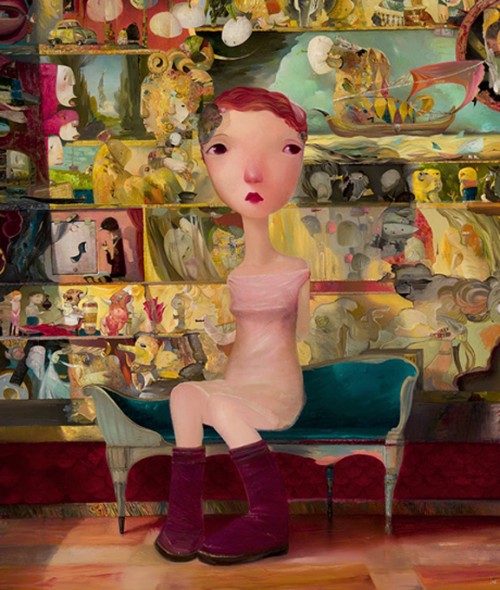
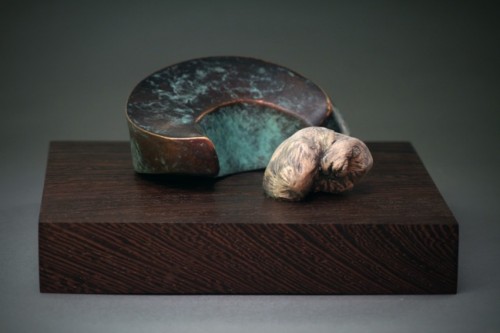
This past November 6th at the Grand Central Art Center, “Interruption” a retrospective of Joe Sorren’s work from 2004 to 2010 opened. Along with new paintings, some collaborative sculptures by Joe and Jud Bergeron were displayed. This January 22nd the exhibition will travel to the Coconino Center for the Arts in Flagstaff, CA. Now that the show is set, and all of the other interviews Joe has done for this exhibition are over, the Creep Machine was able ask Joe some questions about inspirations, working processes, and the work for this retrospective.
Creep: I know that you started painting in college, something you did along with creating music, is there any areas in your painting that you feel could be different had you started at a younger age?
Joe: Not sure, I suppose everything would be different if I started at a different time. Who knows, I never considered it before.
Creep: In some of your works, your love of music is present in the iconography the painting has. Are there any other loves in your life that find their way into your work, on a frequent basis?
Joe: I would say my family always finds their way in there. As does nature, the woods and water in particular. I just can’t get enough of it in!
Creep: You worked first with acrylic paints, and have stated that you liked the simplicity, just water as it allows you “to constantly stare at the canvas.†Using oils now, do you find your working process is the same, or did you have to change the way you work to fit the medium?
Joe: The thing about acrylics that finally pushed me away was, it is incredibly frustrating to chase moments in paint, and then catch them up only to find them dark and dull the next day. I suppose in oil, the prep work is greater, but the moments, once realized, remain.
Creep: For your upcoming solo exhibition, Interruption, you worked with Jud Bergeron on some collaborative sculptures. You have made sculptures before, but there new ones look a bit more abstract in their form. Is this new way your are creating figures a natural progression, or does it have something to do with the collaboration between Jud and yourself?
Joe: I would say working with Jud had to change the way I approach making sculpture. His work has always has a foot in the abstract, and it became a natural foil for my more figurative, love of character, type of approach, yes.
Creep: I’ve always been interested in the process of how artists create their work, and have followed your blog to see the frequent process shots you post. I notice that drawings are something fans rarely see. I know you paint directly with no studies, can you talk a bit how your style has progressed working this way?
Joe: I love the daydream quality to thinking or not thinking, as the case may be, with a brush. The idea of a canvas being full of possibilities to explore, seems much more interesting to me than to plot and plot and then color the plotting, and that only after plotting the coloring, in some cases!
Creep: The quality your paintings have, which was what helped make me a fan, almost gives one the impression that they could fit perfectly within any art period. I can even see in a few of your work, possible inspiration from classical paintings. Can you tell us about your inspirations from the past, and the artists that played the biggest role in your development?
Joe: I am an art lover, and it’s history is so vast and mind-blowingly rich that it really depends on the week. Have you ever read Vasari? His art book, written in the 16th century, is kind of where I am at these days. Just so interesting to hear his ‘ modern perspective’ on things. Makes me realize that we are only in another pod of time now. Check it out if you get a chance,” Lives of the Artists” by Giorgio Vasari.
Creep: You have shown work alongside many artists in the “pop surrealis” genre, yet your art seems to have its own niche. Do you feel comfortable in the place your work has been fitted, or would even a previous movement be something you would rather be a part of?
Joe: Honestly, it’s better for me to focus on the work, and leave those sort of things to consider when I am blind and dead, you know?
Creep: Now that you have added sculpture to your list of abilities, is there any other medium you would like to try?
Joe: Marble is what I cant wait to try. Someday, someday!!
Creep: Your shows have always had a nice space in between them, something I respect as I know you are not rushing like many artists seem to be doing. After a show such as the upcoming Interruption, do you take time off or get right back to work?
Joe: I think it’s really important to jump straight back in, otherwise the dark cloud of not painting can get it’s dry claws into you. Truth is, I can’t think of a better way to spend my time here on earth, family aside.
Creep: Finally, an you tell us whoa are some of the current working artists whose work amazes you the most?
Joe: Turner, Picasso, manhattan steamboat overdrive, Jim Henson, more Picasso.
As Joe stated in the interview, if you are interested in art history, or even the way writing about art has evolved and been influenced, Giorgio Vasari’s “Lives of the Artists” is a must read. It’s something I read for my art history training, and has inspired historians and critics since it was first published in 1550. You can pick up a copy (here) on Amazon pretty cheap.
To check out the full exhibition, and even take a virtual tour head over to Joe’s homepage: Joesorren.com
To see the sculptures Joe and Jud Bergeron created, check out Jud’s homepage: Interruption Sculptures
Coming this December 10th to the Last Rites Gallery in New York, is a new solo show from Genevive Zacconi. A new series of works will be unveiled, and while Genevive is frantically working to make this new show as amazing as we all know it will be, she took some time to answer some questions for the Creep Machine. I know that the site will also be getting some exclusive images of the new works in the weeks to come. Paul Booth and Genevive Zacconi
CM: You went to the School of Visual Arts in New York, as well as the Academy of Fine Art in Pennsylvania. What was your experience like at art school, and what was your art and themes like before school?
Genevive: The themes before art school were much the same in many aspects, but I actually only attended both of these schools for one semester. So in a way, I am primarily self-taught. I found myself cutting class to stay home and work on my own paintings and consequentially decided that formal art training wasn’t for me, but continued in my independent study. The first place I attended, Pennsylvania Academy of Fine art, is the oldest art school in the country. So needless to say, was extremely traditional, with it’s primary focus being on classical portraiture. I grew tired of being reprimanded for changing elements in my paintings to that which didn’t exist exactly true to life, and the overall attitude against modern art. So I decided to go to a more “progressive” art school, and picked SVA. Once there, however, the opposite problem occurred. I’d spend hours on tight, detailed oil paintings, only to have my instructor suggest I do things like fling paint onto it or glue photocopies of insects overtop of my image. Perhaps I was just too immature at the time to take in these different approaches and outlooks, or I just had bad experiences with particular instructors- but looking back on it I think that had I found some sort of middle ground I wouldn’t have lost interest in school so soon. I’ve been lucky, though, to have spent time with incredible artists who have taught me a lot. I worked as painting assistant to Ron English for a year; I would say I took in more from that experience than anything else. Though, I realize I still have so much to learn and feel like I discover something new with each painting I create.
CM: What are some of the biggest influences in your art, this could be artists as well as music, films, and so on?
Genevive: When I first really began studying art history, some of my favorite artists included Frida Kahlo, Cindy Sherman, Salvador Dali and Rene Magritte. Also, this might sound silly, but I’m sure some of the kids movies with a darker, ethereal look that I obsessively watched growing up have had an effect on me. I suppose the music I’ve listened to has had some influence as well- I was heavily into the goth and punk thing in my teens, so I’m sure that has shaped my aesthetic. In the past, I have found myself naturally gravitating toward certain imagery, that I don’t consider particularly dark or offensive, only to have it be viewed as such by others… so perhaps I have a skewed perspective as a result of some of my interests.
Delusions of Candor- oil on board, 18×24
CM:. Much of your work contains symbols of blood, cutting, but there also seems as though there is importance put on the flesh itself. Can you tell us a bit about your symbolism?
Genevive: While I do have certain symbols that are recurrent in my work, and always carry a similar meaning, for the most part the images I employ change dependent on what the particular piece is about. For me, the artistic process begins with reflecting upon my own thoughts and experiences, then transforming them into a concept for a painting- a visual metaphor, of sorts. I have, however, noticed a difference in the imagery that my ideas manifest themselves through. I took a while off from painting to direct, and now coming back into creating art, it seems as though my symbolism has become more subdued, with less of the “blood & cutting” you’re referring to. I can definitely see a divide in the work I created in my early 20’s, before my hiatus, and the work I am making now in my late 20’s. I suppose it could be maturity making my sense if aesthetic more refined, also being around such beautiful, well-executed art while at Last Rites was probably an influence in this shift. I used to consider the visual aspect of a painting as simply a vehicle for the concept, and only chose to paint in a more realistic style because I thought it illustrated the idea clearer and was more relatable to the viewer. Recently, though, I’ve made more of an attempt to focus additional attention to composition, color and lighting. I still struggle though, with keeping true to my initial idea, while making the painting visually pleasing, but not adding arbitrary objects simply for how they look.
One of my main goals right now is perfecting ways to harmonize these elements; to me, some of my favorite artists who are working right now are those who are successful in achieving both. I most enjoy paintings where I feel like I can dive into another world, exist within there, but am also left thinking, questioning what inspired the work, and what the artist is trying to say. Basically, if you can make the right and left side of my brain work at once, you’ve won my admiration. I think content in art is important to me because right now, more than ever, we see pretty images all around us. Everywhere we look there are appealing images in ads, illustrations, designs, digitally animated movies, etc. God, many artists couldn’t paint one frame in a Pixar movie, no less doing thousands of them. Visually, painters have competition right now that was never seen by the likes of Michelangelo. To me, where fine art still maintains it’s strength, is that it is one of the few visual vehicles left that is simply one human being connecting to another. In a painting, there is no big company running things, no marketing team or demographics analytics, no censorship, no advertisement or commercialization. This act of directly plugging into another individuals brain is what I love about fine art. So when I look at a painting I want to view more than an attractive surface, I want to get into someone’s headspace, experience an emotion, a feeling, what someone has been through, what they think. In much the same way, it’s a strange act to be at an art opening, in public, in the midst of polite conversation, and have some of the most personal aspects of one’s mind hanging on a wall for everyone to see (if they care to really look). It’s a pretty amazing thing.
Reciprocity- oil on wood, 8×10
CM: It looks like you started curating shows before exhibiting your own work. What does curating fulfill for you in opposition to creating art?
Genevive: Actually I was exhibiting my own work before curating, and that is what led me into showing the work of others. Despite the fact that I stopped directing to return to my own art, I absolutely love working for galleries. I have found it hard to return to painting in some ways, as it is situationally opposite to directing. In many ways, curating is a very social job, whereas painting requires many hours in solitude- which I have definitely had a hard time re-adjusting to! I do miss the constant interaction with other artists, bringing together interesting people, thinking analytically, the satisfaction you feel when a show you’ve organized has done someone’s work justice, and being in such close quarters with amazing art. At the risk of sounding juvenile- one of my favorite things is when a show gets delivered, it’s like Christmas to me. I get to unwrap boxes of some of the most remarkable objects in existence. Then I get to spend time alone, without distractions, just looking at great paintings, examining each brushstroke in detail… in a way no one ever will get to at an art museum in years to come. Not too many jobs are cooler than that. However, I believe that you cannot run a gallery and make/ exhibit your own work at the same time. Because of this I decided to retire as director of Last Rites, but I still continue to guest curate occasionally. The next show I am putting together is at Copro Gallery in July 2011: Ewelina Ferruso and I have a two-person show of our work in half of the gallery and I am curating a group show in the other half.
CM: You were the founding director of not only Trinity Gallery in Philadelphia, but also of Last Rites Gallery in New York. Can you tell us how your involvement with Last Rites Gallery came about?
Genevive: When I was directing at Trinity Gallery I curated a show for Joe Capobianco, a very well known and respected tattoo artist. He was acquainted with Paul Booth through the tattoo community, and when Paul was looking to open a gallery, Joe suggested me. I had been an admirer of Paul’s art for quite some time, and felt as though he and I hit it off almost immediately, sharing the same vision of what Last Rites should be.
CM: Your work has been shown on the West Coast as well as in galleries on the East Coast. With galleries such as Last Rites being in New York, have you noticed dark art being looked at differently between the two regions?
Genevive: I haven’t noticed my work being received differently in LA than NY. I’ve been in attendance at openings I was in on both coasts, but with the way the broader art scene is, it’s the same circle of artists and buyers. At least in my experience, it seems as though it’s all the same pool of art aficionados.
Good Exposure- oil on canvas
CM: Why do you think dark works of art get overlooked, or brushed aside as opposed to the more mainstream works of art?
Genevive: Historically, there have been many well known artists who’s work could be construed as “Dark”, such as Goya, Bacon, and Bosch- so I don’t know if I can totally agree that it’s been overlooked altogether. Also, my answer to this question might vary slightly dependent on what facet of the art world you’re referring to with the term “mainstream”. But in general, perhaps it hasn’t been embraced quite as much because for anyone buying art merely as house decoration, often times it just doesn’t fit. The term “Dark Art” does not just imply a darker color palette; instead, much of this work forces people to face uncomfortable feelings, repressed emotions, and societal taboos. This generally isn’t the type of thing you buy simply to match your couch.
CM: This current scene of art has switched names a few times now, but as a curator and artist can you tell us your views, positive and negative, about this rapidly emerging scene?
Genevive: I think that the reason this scene is growing so quickly in contrast to those past is because what we’re witnessing is one of the first movements in art to be nursed by the emergence of the internet. On the positive side, it’s easier than ever for artists to self-promote and gain exposure to collectors; likewise, movements happen in a more global and diverse way because we can all see each others work immediately, despite geographic differences. It’s also totally changed the way in which galleries operate. Many collectors don’t even see a piece in person anymore before they purchase, the majority of sales are made via internet. I’ve had collectors who lived less than an hour from Last Rites, buy work from the website, have it shipped, and never come into the gallery. Often times with the way things are, buyers must act faster- With an artist in high demand, it’s a mad dash to get a piece first when the online preview is released.
But on the negative side of the additional exposure (and I suppose things have always been this way to some extent)- while the vast majority of collectors I’ve worked with genuinely love the art they buy for it’s intrinsic value, sometimes I get the feeling that there are people out there buying certain work like it’s collecting baseball cards. They need to have a piece by each of the “key players” in this scene, without really valuing the artwork for what it is. In those cases, they generally want to have what they consider the quintessential piece from that artist: meaning the one that they feel is recognizable because it looks most like the artist’s other work. This trend sometimes stifles artists, as they are basically forced to re-create the same painting repeatedly and cannot grow and change. I have heard many artists complain about this. Looking at the career of someone like Picasso, who had phases in his art like his cubist period and blue period- I wonder if this environment will produce an individual with such an epic and diverse body of work, or if this interference is forcing artists to make a consistent product instead of encouraging them to create in a more genuine, intuitive way.
Portrait of Genevive by Shawn Barber
CM: You’ve been the subject of a few paintings so far, can you tell us the feeling of being immortalized by fellow artists? Are there any artists you would love to pose for, living or dead?
Genevive: Yes, I’ve been lucky to have been featured in the work of some extremely talented artists, it’s an honor. I also find it really interesting to see how different artists perceive the same individual- what features become most prominent, the expression they capture, the emotion the work exudes. Just last month I had the pleasure of modeling for the incredibly talented Natalia Fabia, so that will be the next painting I’m in, very much looking forward to seeing the finished product. As for who I’d like to model for… I’ve actually never thought about that before now, and had you asked me this a few years ago my list would probably include some of the artists that I’ve since posed for. Of course it would be astounding to have a portrait by Ingres, it also seems like it would be fun to model for David LaChapelle.
Disillusion- oil on wood, 22×30
CM: You have a new solo exhibition opening at Last Rites this coming December. Can you give us an idea of what these new works were inspired by?
Genevive: I started sketching out some of the work in this show quite a while ago so some of the paintings that have transpired represent different phases of bigger situations. Overall, I guess the themes on this one are attraction, love, deceit, and heartbreak. The mood of the show is particularly melancholy, and it’s titled “Dysphoria”. However, as I am now finishing up these paintings, I find myself in a different state of mind than when I begun. I am happier now than I have been in a while, so it’s taking a lot out of me to force myself to be back in the headspace I was at when I conceptualized and started some of these pieces. I think my next body of work will feature a few paintings that are less downtrodden and instead have more spunk and attitude, but I have found the past few months to be a great catharsis.
For this months, slightly late double feature, I was able to get an interview with Canadian illustrator Jason Edmiston. There is also a nice gallery featuring 20 images of his work, so make sure you check that out after reading the interview.
CM: Can you tell us a bit how you got started in art, did you go to any art school for your training?
Jason: Not sure how far you want me to go back, but I actually knew I was going to be an artist for a living since I was a child. I never thought I would do anything else, and luckily it worked out. I had regular public school and high school art classes, but after that I went to the Ontario College of Art (now called OCAD because of an increased design department). It was a four year program, where the first year focused on foundations of art, and you specialized in an area over the next three years. I went into Communication and Design with a focus on illustration. Although school was a good way to get exposed to and prepared for the life of a working artist, I felt that I still needed to tighten my portfolio to get regular paying gigs. After college, I continued to teach myself through trial and error practice, and by pouring over my large library of art books. (more…)
For the month of June, we have another single artist feature with interview, this time from Joe Scarano. Joe Scarano was born in Warwick, NY in 1975. He was raised alongside a litter of sisters in Miami, FL and later in Bethpage, NY.
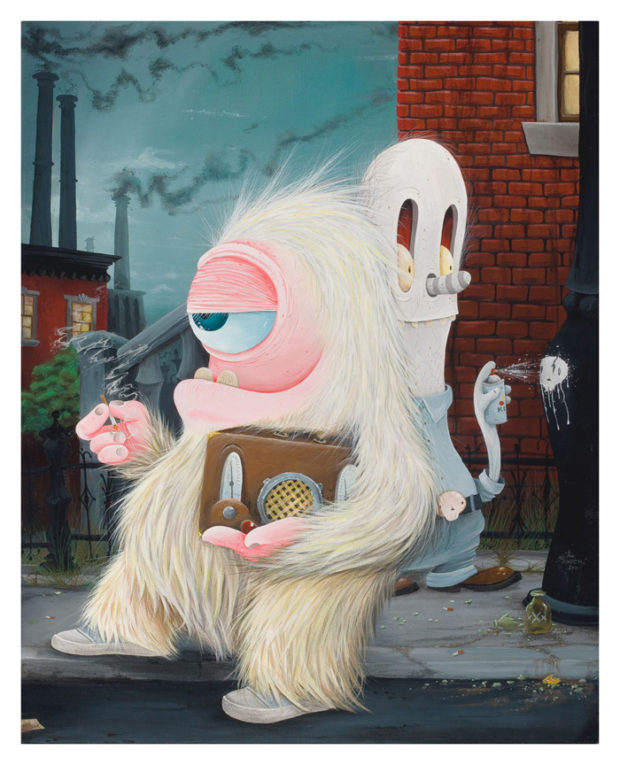
During the day Joe works as an online art director for a non-profit consumer advocacy group. He spends his nights painting characters and environments that recall the odd early days of animation and the dingy despair of the 1930′s. With their popsicle stick bucktoothed grins, hollow heads and dead eyes his characters often straddle the lines between funny, tragic, grotesque, and sad.
He currently lives in Orange County, NY with his wife Marci, son Mason, and several furry creatures.
Cm: You grew up in Florida and New York, were you active in creating art during your childhood?
Joe: Yes! I was always drawing and doodling for as long as I can remember.
As a youngster I was always drawing really elaborate space battles and hot rods. I was also obsessed with Mad magazine and trying to re-create the covers.
Eventually I graduated to painting heavy metal album covers on my friends denim jackets. I once painted Cannibal Corpse’s Butchered at Birth album cover on a friends jacket, I had to hide if from my family for fear of being put into a mental ward!
Cm: Are you mainly a self taught artist, or did you have any formal training in the arts, such as a university or private school?
Joe: Kind of half and half… I took art classes all throughout school and then studied graphic design in college. I never focused on illustration or painting during school, I picked up most of that after I was already working as a designer.
Cm: It says you were inspired by the golden age of animation. What are some of your favorite cartoons, and some of the artists that inspired your work?
Joe: As a kid I loved Popeye, Woody woodpecker, Tom & jerry… all the classics. Just about anything by Tex Avery! I grew up expecting cars to come equipped with miniature 1940’s pin-up gals in the glove box. Max Fleischer, I remember seeing Steamboat Willie at a young age and being fascinated by it… it all looked so strange. A lot of the early animation from the 20’s and 30’s definitely inspires my work now. It’s all very surreal and psychotically happy.
Cm: I know that you use cel vinyl acrylic and standard acrylics in your works. Can you tell us a bit about cel vinyl, how it compares to standard acrylics, and the benefits of using it?
Joe: Cel vinyl dries super fast and really flat. Most of the colors are super opaque too. I find it works really great for dry brush techniques, I’m able to achieve a lot of looks that are generally done using gauche but cel vinyl is much easier to use… for me anyway.
Cm: Looking through your work, a few of the characters seem to pop up in more than one painting. Do you have any of these characters named, and what inspired them?
Joe: I have a few of my characters named… choxy, ol’ Gyp, Stitch Wilson. A lot of them are inspired by some of the crazy stories my father tells from back when he hung around with some real misfits. Other characters are inspired by various sources, music, movies, endless hours of nonsensical conversations with friends, crazy shit I have stumbled on in old stores, hobos, the belief that woodland creatures really can speak and are plotting our destruction, the insane fears you had as a child, any tragically funny situation really.
Cm: Can any of your characters be considered a self-portrait?
Joe: I think the closest I have come to doing a self portrait is probably young Mortimer Minworth from my school portrait series.
As a wee lad I hated school pictures, most of my school pictures feature a very forced and barely visible smile.
I think those pictures really inspired that piece.
Cm: Who are some of the current working artists that inspire you, and any artists that you would love to collaborate with?
Joe: Ah… there are so many great artists out there today. Dave Cooper, Colin Johnson, Dan May, Heiko Muller, Ryan Heshke, Brandi Milne, Greg “Craola” Simkins to name a few.
Cm: I see that you don’t have any drawings or sketches added to your site or other profiles. Do you do a lot of sketching before working on a painting?
Joe: I tend to sketch very randomly, usually in the margins of some work document or all over my notebook during meetings. In the past my sketches have mostly consisted of a central character or the characters head and I would build around that once I started painting. With my more recent pieces like The Corner Boys I will do a very detailed sketch on the surface that I’m going to paint. Once I am happy with the sketch I coat it in clear gesso and paint right over it. So most of my detailed sketches get covered over with the final piece.
Cm: What are some of the things you do while painting; any music, movies or other inspiration to get the creativity started?
Joe: While I’m painting I always listen to music, I find TV way too distracting! If I had a TV in my art room I would wind up watching all sorts of crappy movies in stead of actually painting. Recently I have started flipping through old art history and illustration books as reference while I am working things out. It helps get ideas going as well as how to execute certain techniques. I am working on a piece that is set on the sea and getting the ocean water right has been difficult… it’s good to have that reference material around.
Cm: Being originally inspired by animation, and clearly skilled in character design and the materials needed for animation. Have you ever though about creating a animated movie or series based on the world you have created?
Joe: I have thought about it from time to time, I even started a flash based animated comic with a friend but it died in the early stages. I would love to create some sort of animated short based on my characters and their sad little world. There is so much that goes into animating that I would not even know where to begin.
Cm: Finally, are they any types of inspirations, hobbies or music/art that your art would not give the indication you enjoy?
Joe: I love riding my motorcycle, but I seem to do that less and less now that I have a youngster of my own. I do a lot of playing with matchbox cars and Tonka trucks nowadays which is actually a lot of fun.
For this months feature, the Creep Machine not only had the pleasure to show the art of Vincent Castiglia, but to also interview him. I do hope what is recorded below will give viewers a greater understanding into the artwork that Vincent creates, but also to foster a greater appreciation of it. Vincent creates his paintings with only the use of his own blood. Looking past the medium one can clearly see that he is creating allegorical paintings, dealing with the ideas of life, death, and rebirth. Works of art that are iconic and timeless. I would like to thank Vincent for taking the time to answer these questions.
Vincent: I began drawing as soon as I could hold a pencil and comprehend how to make a mark on any given surface. Making art began like “The Great Escape” for me, and the most efficient way to disconnect from the war zone of what appeared to be a home from the outside world. Those initial marks on paper, walls, or just about anything I chose to draw on would pave the way to a much more contemplative sphere of reasoning and technical execution than what was possible at three or four. But nonetheless those early markings were the formative acts which were to unfold into a tree of destiny, the fruits of which are now my sustenance and the life of my flesh. (more…)
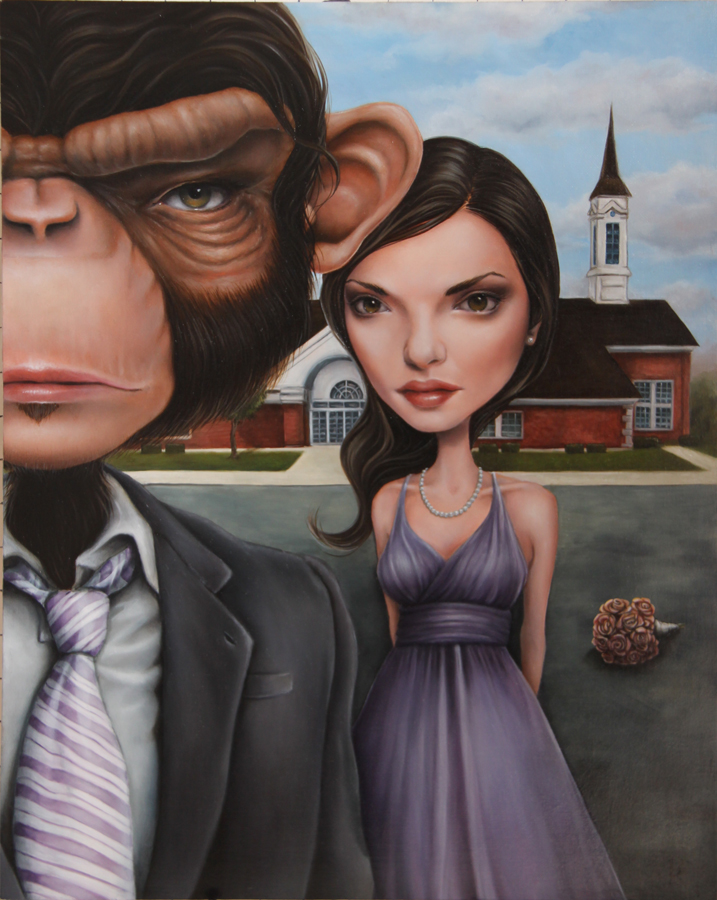
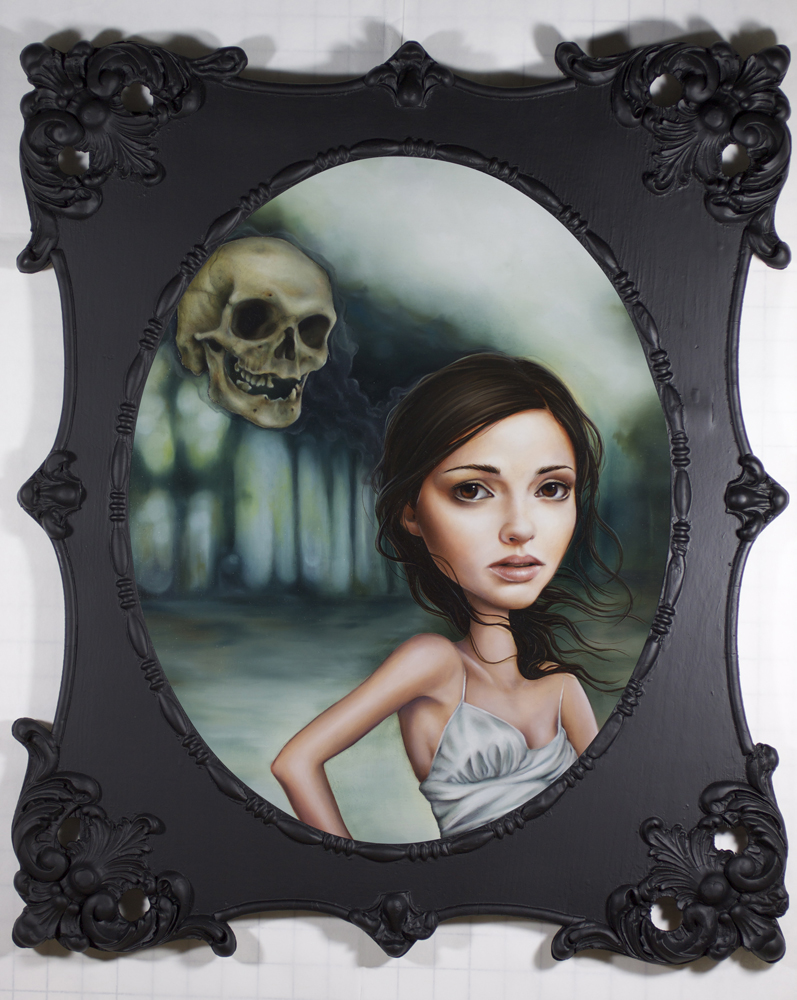
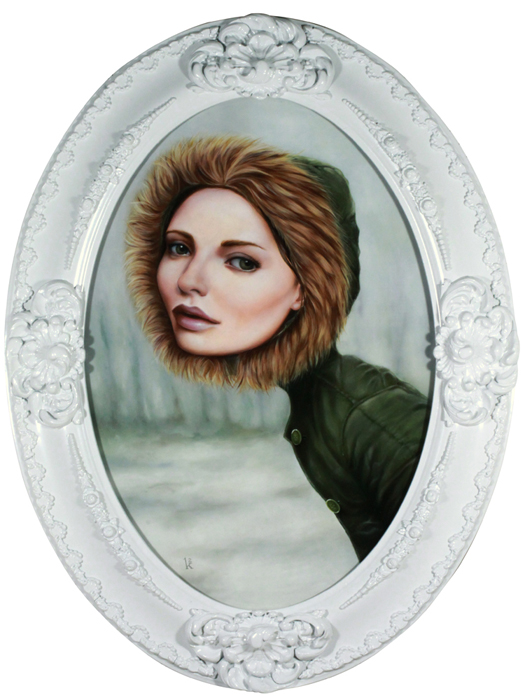
Ken Keirns is an artist based out of the San Francisco Bay Area. He’s been exhibiting his work in galleries for the better part of a decade – recently at Rotofugi Gallery (Chicago), T&P Fine Art (Philadelphia), and Dorothy Circus Gallery (Rome, Italy). In the world that Ken depicts you’ll find a few monkeys. The archetypal alter ego? A noble way of acknowledging the common traits between man and the other species we share our world with? You’ll also find lots of women, and a bit of commentary on gender relations that occasionally strays to the dark side of the aisle: Where cautionary tales of Love Gone Wrong dwell. We set out to uncover a few answers about the man responsible for Hot Babes in Toyland, hitman chimps, and Common Nonsense.
The Creep Machine had some help from Joe Almeida, an art collector out of Southern California who was nice enough to work up some questions for Ken.
CM: Ken, what was your childhood like in America’s so-called Rust Belt? Was growing up in Flint, Michigan as harrowing as depicted in Michael Moore’s film Roger & Me? Was your family particularly artistic or eccentric and did they support your creative pursuits? Was your comedic IQ evident at a young age? Any clues you can give us that would provide insight into your current work?
Ken: I had a great childhood growing up in Flint. It has seen better days, but I really hope it makes a come back. My Family has always been supportive/patient of my creativity. My Mom has quite a large stash of my early scribbles. When I was a kid I loved drawing, making things from junk and building model kits.
“Where the Wild Things Are” has always been my favorite book. Maurice Sendak has such a great style. I still have my tattered original copy of the book. I loved Godzilla and Star Wars, anything with monsters or spaceships. Hot Rods were also a big deal to me as a kid. My parents would take me to see the custom car shows that came through Flint every year. So, I guess my tastes really haven’t changed much.
CM: As a child, what was your favorite dinosaur? (As you can tell, this interview will be a serious but hopefully not overly invasive probe of your psyche. Whether your choice is an herbivore, carnivore, sea dweller, etc, your chosen dinosaur will be submitted to Creep Machine’s resident anthro-paleontologist for analysis, helping us glean further insight). You are permitted to cite a Kaiju monster from Japanese cinema in lieu of a dinosaur (we have teratology experts on staff as well).
Ken: Definitely a T-Rex, he was the king of the dinosaurs, though Godzilla and Gamera are also pretty awesome.
My first showing was at a Kindergarten parents’ night. They showed my drawing of a Brontosaurus, displayed on a little easel. I don’t know why I drew a Brontosaurus rather than a T-Rex. Maybe I didn’t think I was ready for that kind of pressure in my first show.
CM: Later in life you spent about 7 years in Chicago before finally relocating to the San Francisco Bay Area in Northern California in 2007. Were those relocations fraught with any bit of culture shock or were they welcome and maybe necessary changes?
Ken: Before I left Chicago, I was living two floors above a nightclub, so moving to the suburbs in California was quiet. I mean REALLY quiet. That took a lot of getting used to. If you were out in Chicago and it was quiet like it is here, you can be pretty sure you’re the last one alive after some kind of apocalypse. Also, I learned after being gone for just a year that I have completely lost my parallel parking skills. Who would have thought that was such a fragile skill? The main benefit of moving was to allow myself to focus on painting full-time. In Chicago, I juggled a full-time day job while painting nights and weekends. I was lucky if I could swing 4 hours of sleep a night. It wasn’t pretty and I didn’t feel like I could keep that up for much longer. All of the California sunshine does help the paint dry faster, but I do wish it snowed here occasionally…
CM: The initial impetus for including anthropomorphized Simians into your work was simply to terrorize your best friend and his maimouphobia (aka pithikosophobia) affliction in a fun way. Has it proven effective? Does he still possess an irrational fear of the creatures?
Ken: No, Jimmy has gotten over it. In fact, I think he actually forgot about his fear of monkeys all together (or he was faking the whole time). so maybe this sort of therapy is successful? When he first moved away I would send him boxes of thrift store monkeys. One year he decorated his entire Christmas tree in monkeys.
CM: As your work evolved, you have confided that sometimes the monkeys (and other anthropomorphized animals) in your paintings are a personification of you. Is this a means of self-deprecation in order to keep things on a lighter note?
Ken: Sometimes. Also, the chimp is much cuter then I am, so I’m guessing he appeals to a broader audience.
CM: An artist’s work evolves over time, along with those of us who imbue it with personal meaning. Is it important to you that others understand your work? Are you comfortable with baring your fears and desires on canvas? You employ humor to great effect in many of your works. Is it fair to suggest that your sense of humor is in effect sometimes a personal coping mechanism? And maybe a means of keeping your intended meaning less transparent than is necessary? Are you okay with a large contingent of the “art community” potentially not being able to see past the joke?
Ken: Yeah, it definitely can serve as a coping mechanism. I like to keep the paintings ambiguous. I do think it is important for people to understand the work, but if it’s not self-evident then I’d rather let it be “just art”. Also, plenty of times, viewers have made up much more interesting stories than I intended, so that works too.
CM: Your collective body of work can easily be interpreted as an ode to femininity, especially the portrait paintings. Any specific motivation behind your primary subject matter?
Ken: I’ve been painting women as my main subject matter for quite a few years now. I never get tired of painting them. I think that they make perfect storytellers.
CM: Your girls’ beauty and elegance can also be seen as the lure of the siren’s web, however. Sometimes you can’t resist making less-than-subtle commentary on gender relations, with, of course, a dose of your requisite sense of humor. Surviving the treacherous terrain of modern day relationships, especially those of a highly volatile nature, isn’t easily done without casualties in the world you depict. Do you consciously try to mask these ideas with humor for the very reason they can be personal and sensitive issues? Do you get a lot of feedback about this aspect of your work? Are there differences in the way men and women respond to your paintings?
Ken: I wouldn’t say that I’m masking issues as much as I’m exaggerating them to punctuate what I’m trying to express. And, basically, the added tension of murder, betrayal, possession or heartbreak just makes it more fun to paint. I use personal experiences and dreams as a starting point, but along the way they are rearranged and exaggerated. Troublemakers are much more fun to paint than saints. I usually get similar reactions from both men and women. Although most of the paintings are bought by men.
CM: Your work is hardly insulated from the dire conditions of today’s world. As evidenced by your works “Harbinger”, “Fishing”, and even “Security”, you will occasionally venture into darker territory. Are you compelled by any specific reason to at least subconsciously acknowledge the heart of darkness every now and then? Can you talk a little bit about “Harbinger”? Do you recall how that piece originated? And how about “Security”?
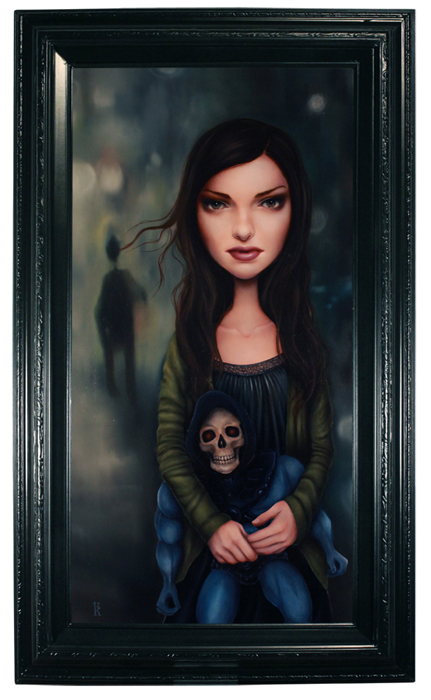
Ken: I do occasionally visit the darker subject matter, it kind of depends on where my mind is at. I meant “Harbinger” as a more literal version of the little storm cloud that follows you around when you are down in the dumps. She is holding the string, so the feeling of doom is self-inflicted. “Security” is about isolation and insecurity. The Skeletor figure is the wall that you hide behind to protect yourself from the unknown. The “unknown” depicted as the out of focus figure in the background. “Fishing” is about blame and guilt. The skull represents the “issue”, which is lined up over the blurry figure’s head in the background. The blurry figure may or may not be the cause of the “issue”.
CM: Can you tell us a bit about your technical and/or creative process? Do you keep a sketch book? Do you use a magnifying lens for the near-microscopic details? Your preferred mediums now seem to be oil on canvas or board. Have you experimented with other mediums? In the past you have worked with an airbrush, with sculpture, etc. Why did you ultimately settle on oil painting?
Ken: My creative process is kind of messy. It begins with an idea, like a memory with potential or a fun play on words. Then I scribble it onto a piece of typing paper. If it has a tricky composition I will draw a rough version and transfer it to hardboard, otherwise I will draw directly on the surface. I prefer using loose paper, instead of a proper sketch book. I have several folders of rough sketches and ideas filed away. No magnifying glass, just a lot of squinting. I came to settle on oil paint because I really like the depth that I can get from building the layers. Also, I love the longer drying time that oil offers. I have a tendency to rework things, so this is very helpful. I have wiped away many a head. I also love sculpting and mixed-media assemblage. I hope to get back to spending more time on that at some point. I worked with airbrush and acrylic for many years. I still occasionally use acrylics for time sensitive projects, but I prefer oil. I haven’t used my airbrush in years. I’ve been reading up on resin toy making, so hopefully something will come of that shortly.
CM: As you continue refining your work, it appears you are steadily but subtly experimenting with your backgrounds (i.e. the glimmer of night lights, sunlight as filtered through foliage or the headlights of an oncoming car). And although not nearly as extreme as say Charles Schulz’ Peanuts characters, you’ve also experimented to varying degrees with the levels of afflicted hydrocephalus in your girls (i.e. “cranial endowment” as you’ve termed it). Very few artists (such as Mark Ryden or Joe Sorren, and now yourself) are adept at pulling this off. Are these stylistic flourishes ones that evolved naturally or is it a result of experimentation and trial and error?
Ken: The bokeh style backgrounds I’ve been working with lately are a lot of fun to paint, but sometimes I prefer to place the characters at the scene of the crime.I would like to blame the cranial endowment on the artist that drew my caricature as a child at Cedar Point amusement park. I have a big head, but c’mon!
Painting the head is my favorite part, so I guess it makes sense that they are larger than life. I used to paint large scantily clad women on doors (the “Door Whore” series. Yeah… classy). They all had large heads. I kept the scale, but changed the subject matter.
CM: Speaking of Charles Schulz, probably the only author/artist that provides entry level philosophy for children… Which Peanuts character do you identify with most and why? (This is the 2nd of our Rorschach-style psychological probes).
Ken: Linus (with a dash of Pigpen). I’m still waiting for the Great Pumpkin.
CM: It isn’t difficult to imagine your art-making process as a meditative and perhaps even self-exploratory experience. Do you ever think of your work process in those terms (i.e. cathartic, therapeutic, etc)? As for your work environment, do you prefer to paint in silence, or do you listen to music or have the TV on for background noise? Are you nocturnal or do you work best during the day?
Ken: Painting is definitely cathartic. A teacher of mine once described my work as a Sin-eater. Painting definitely keeps everything in check for me. I prefer to paint during the day because the light is better. However, I do tend to be more productive at night. My sleep schedule shifts depending on upcoming deadlines. I usually put in a movie that I have seen a million times, that way it keeps me company but isn’t distracting. I have listened to the DVD menu for Goodfellas for hours at a time without realizing it. I used to listen to music, but for some reason I haven’t been lately.
CM: In recent years, you have achieved relatively good success as an artist without much fanfare. A hallmark of this corner of the art world is hype amplified out of all proportion. Yet, without being the beneficiary of the incessant campaigning from various cliques or coteries, you’ve managed to build and sustain an avid, loyal, and ever-growing following. It must be gratifying, yet frustrating at times, I imagine. Do you feel you have fully adjusted to your career as an artist? What are things you like and dislike about exhibiting your work and having to delve into the business side of things?
Ken: Yes, “gratifying, yet frustrating” is a bit of an understatement. I enjoy the creative process and painting. I find it challenging to make the time to keep up with all of the social media and networking part of the job. That can be a full-time job in itself! Also, openings can be tough. I’ve never been very comfortable in the spotlight, I’m kinda fidgety.
CM: Thank you for taking the time out of your busy schedule! Any final words you’d like to say to the fans of your work and to the readers of Creep Machine?
Ken: Thank you, Joe and Josh, for taking the time and having interest. Thank you readers for taking the time to read this. I really hope I didn’t sound like an idiot.
Thanks Ken and Joe for a great interview. Make sure you stop by Ken’s homepage for more work, and join his newsletter to keep up with current happenings. Ken Keirns Homepage
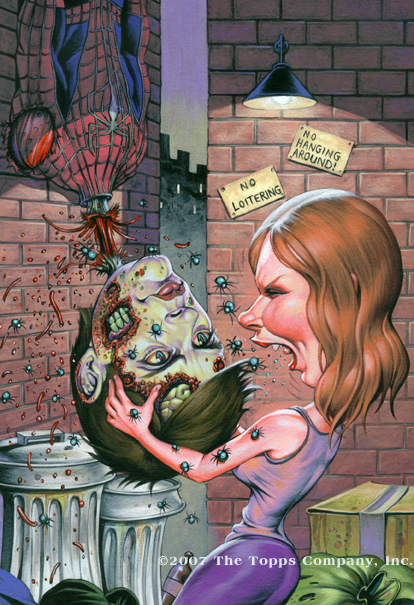
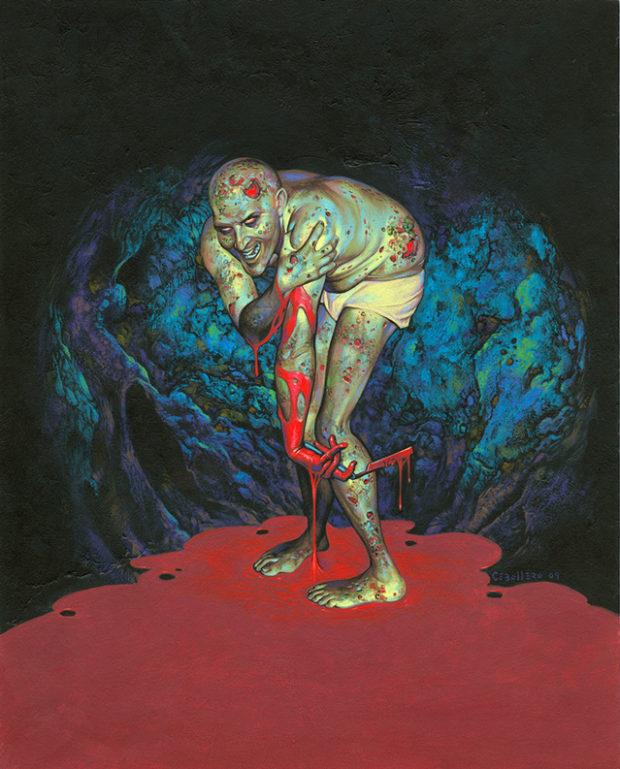
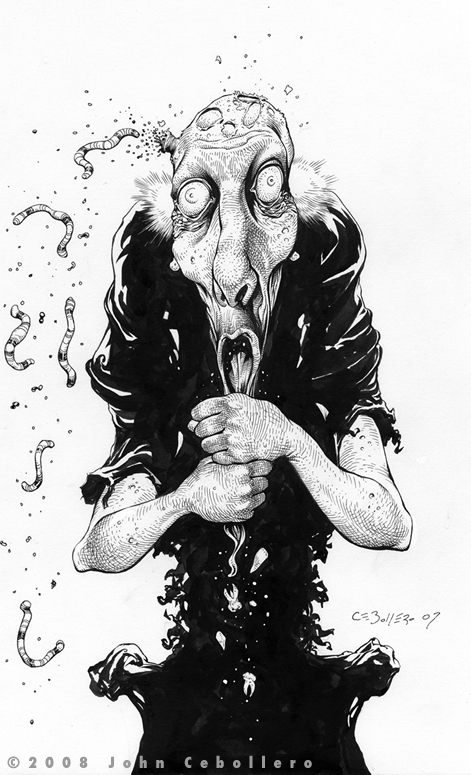
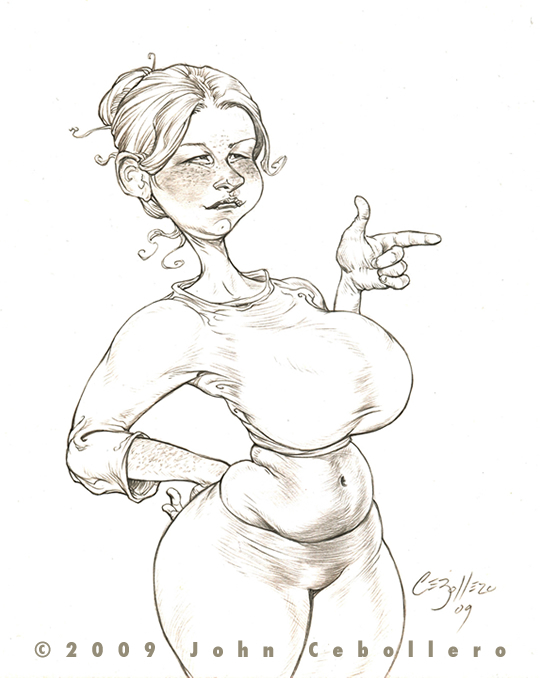
John Cebollero is an artist out of New York City. I have been a fan of his work for quite while now and was able to show his work in not only the “Attack of the B Movie Show”, but the recent “This is the End” group show as well. Whether it’s with pencil, acrylics or ink, John’s work is always inspiring.
CM: How did you get your start making art, any formal training such as art schools?
JC: Like most artists I’ve loved art since childhood. Constantly drawing and exploring the work of artists I admired. Graduated from Art & Design High School in New York City and attended the School Of Visual Arts…for one year, then dropped out.
CM: What are the main influences that helped to develop your style?
JC: I was into magazines like MAD, CREEPY, EERIE, and HEAVY METAL. As a kid I found these publications titillating and viewed them with a degree of awe. They gave me something to aspire to. It was a wonderful time of discovery for me. As for artists, my influences have been Richard Corben, Mort Drucker,, Frank Frazetta, Moebius, Robert Crumb, Vaughn Bode, Gerald Scarfe, Maxfield Parrish, Alphonse Mucha, Norman Rockwell, and Gustav Klimt.
…and of course, things I see every day influence me.
CM: The women you draw are very unlike a majority of what is being drawn today, it reminds me a bit of what we would see with artists such as Bill Ward. What are the main factors that influence your style of figure drawing?
JC: With my art I am trying to convey how I feel about the subject and what fascinates me about the female form. Show the details and spirit that catch my eye and try to ground my figures with an essence of reality. Pushing the contrast of form and color to infuse a life force into them. My women aren’t meant to represent a commercial sense of beauty. Rather a more common, provincial attraction. “The girl you secretly have a thing for.”
CM: Your ink work, as well as the acrylic paintings I have seen of yours, are created with machine like precision. Is there a medium your prefer over all others?
JC: If I create something and I’m very happy with the final results, what ever I used to create it, that’s my favorite medium.
CM: Your gallery has a lot of “zombie” themed works. Are you a big zombie movie fan, if so what are your favorite flicks?
JC: I’m not a HUGE fan of zombies. Most of those pieces were for clients and some were to cater to an audience. I have drawn some gross pieces from time to time but they are meant to be more symbolic than literal.
As for a movie, the original “Dawn Of The Dead.”
CM: I love the idea of collaborations between artists, such as your work and Glenn Barr would be amazing, are there any artists you would love to work with?
JC: Honestly, I don’t have anyone in mind for a collaboration off the top of my head. There was my collaboration with Richard Corben a few years ago. That was a dream come true for me. That “collab” is in my sketchbook JIVE ABOUT…which is available for purchase off my website…for those who are interested!
Yeah, Glenn Barr would be a cool artist to jam with. I guess if I really thought about it, being that I’ve already worked with Corben….Robert Crumb would be at the top of my list!
CM: You have done work for DC & Marvel Comics. Is there any chance we will see a comic, that much like “The Goon” will be mostly produced by you?
JC: People have asked me about this before. I have a project in mind, but it needs to be solidified and most of all….started. I just have to get off my duff and do it. Sorry I can’t give you more.
CM: Besides Vinyl toys and the occasional sculpture, the galleries seem to be limited when it comes to 3D works. Have you ever though about bringing your figures into a sculptural form?
JC: Actually, I have created a couple of small sculptures over the years. Though not credited, I have a sculpture in The Big Book Of Breasts published by Taschen. Not one of my better pieces, but it’s there. You’ve convinced me to start a sculpture gallery on my site. Hopefully it’ll prod me to create more.
CM: If you couldn’t make art, what would you be doing?
JC: The laundry.
CM: Finally, one piece of advice you would give to budding artists?
JC: Stick to your guns with your art, make lots of friends, and press on.
That’s all, thanks for taking the time to answer these.
For more on John’s work, head on over to his homepage: JohnCebollero.com
Make you sure check out his shop, as he still has some sketchbooks there and often adds prints and originals.
You can also add him to Myspace here: John Cebollero Myspace