A while back I posted about the idea of adding criticism as a feature to the site. The idea was equally met with praise and encouragement as well as some pretty nasty e-mails. As I stated before, there is some really exciting work being created right now and there is no doubt that this art needs to be talked about and shared. I have heard from many that inner criticism, along with scholarly writing that seems to be lacking in the current art scene, is what will draw outside interest even more. While I agree with this, formal criticism will not be a feature of this site.
(more…)
Blog
-
Site news: Criticism as new addition? (Update)
-
Eyewriter provides a creative outlet for paralyzed artists
It’s technological advances like this that make me excited to see what the future of art will be like. Tony Quan aka Tempt is a graffiti artist, and now due to being paralyzed from Lou Gehrig’s disease he can no longer create art the way he used to. This is where eyewriter comes in. With a computer, the open source software and and eye tracking system people like Tony can get back to create art again.
This is such a great idea. It shows how important art is, not only for the people who create it, but for all of us. Take a look at the video, get your spirits lifted and then make sure you head over to eyewriters website and have a look around. I can’t wait to see where this technology goes.
The Eyewriter from Evan Roth on Vimeo.
-
Mastodon / Dethklok Screenprint by Anville
Thanks to omgposters.com for the news on this one. Anville has just released a new print for the outstanding Mastadon, Dethklok, Converge and High on Fire show for November 12th. There are three versions of the poster available, Regular which is 24″ x 30″ is in an edition of 40 for $45. The hades variant is limited to 13 for $100, and the orange metallic version is limited to 11 for $100.
Get em here: Anville Store

-
ART THAT CREEPS: Gothic Fantasies and the Macabre in Contemporary Art
ART THAT CREEPS: Gothic Fantasies and the Macabre in Contemporary Art is a new book released by Korero Books and put together by Yasha Young, owner of Strychnin Gallery. The book is 192 pages, hardcover and is filled with “Neo-gothic visual energy and inspiration from the worlds of lowbrow and neo-surrealism. Featuring artists from all corners of the globe working in oil, digital, sculpture, engraving, porcelain, taxidermy and photography.” Some of the artists that can be found in this collection are Chet Zar (cover), Michael Ryan, Scott Holloway, Natalie Shau, Naoto Hattori, Nicoletta Ceccoli, David Stoupakis, Richard A. Kirk, Jason Shawn Alexander, Leslie Ditto, Melissa Forman, Chris Peters, Michael Page and more.
The book can be found in a variety of online shops, but it looks to be ready for purchase now @ Korero Books
-
New prints by Yoskay Yamamoto & Nate Frizzell @ Paper Tiger
A Paper Tiger has just added two new prints to the shop, “Lost Or To Be Lost” by Yoskay Yamamoto and from Nate Frizzell “And Out Come The Wolves”. Both prints are 12″ x 15.5″ on archival textured fine art paper, signed and numbered in editions of 25 each. Both prints look great, and knowing the quality that Paper Tiger puts out they are sure to look amazing in person.
Get em here: A Paper Tiger


-
Preview: “Natural Wonders” and Eric Davison @ Lebasse Projects
Opening this Friday, November 13th Lebasse Projects will open two very exciting shows. “Natural Wonders” will take place in the main room and features art from James Roper, Jeremy Asher Lynch and Kevin Taylor. In the project room will be “Hollywood Ambassador”, a solo show of works by Eric Davison. I’m posting the statements for both shows after the jump, they give great insight into the goal of these works.
I really love the idea behind James Roper’s work. The contrast of the color explosions with the beautifully rendered figures in graphite looks amazing. Each figure in the series of “The ecstasy of…” is dedicated to a porn starlet, but the identity is really only known by the name that is given. In this respect I think the viewer focuses more on the energy in the piece, as opposed to “who” the painting features.
I was also very taken with the series by Eric Davison. All of the works are watercolor and ink on paper, and man does he know how to rock those watercolors. The content on of the paintings in a way can be depressing, but with the skill and execution of the work the artist has given these people a very dignified presentation.For the full preview of the show, head on over to the gallery: Lebasse Projects
-
“Ars Incognito” print by Carles Gomila
Fine Grime UK has added a new print by Carles Gomila. “Ars Incognito” is roughly 30″ x 20″, signed and numbered in an edition of 50. The store still has a few other prints from Carles, so while your over there check the rest out as well.
Get em here: Carles Gomila @ Fine Grime

-
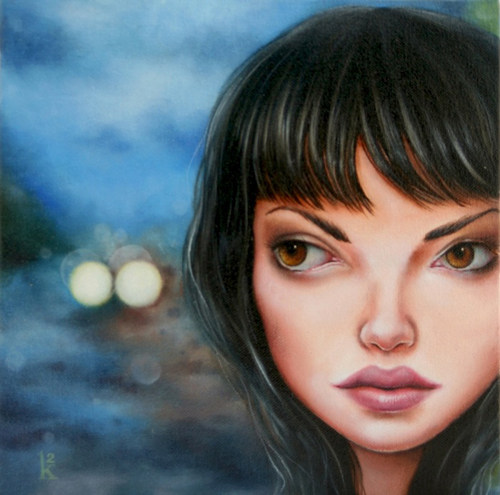
Interview: Ken Keirns
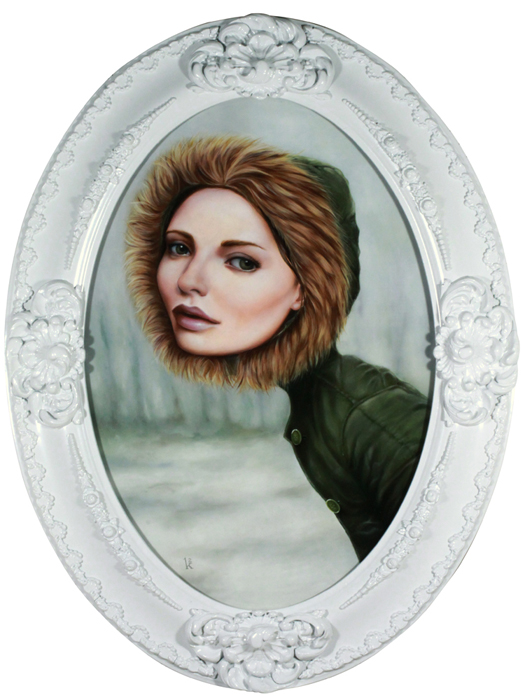
Ken Keirns is an artist based out of the San Francisco Bay Area. He’s been exhibiting his work in galleries for the better part of a decade – recently at Rotofugi Gallery (Chicago), T&P Fine Art (Philadelphia), and Dorothy Circus Gallery (Rome, Italy). In the world that Ken depicts you’ll find a few monkeys. The archetypal alter ego? A noble way of acknowledging the common traits between man and the other species we share our world with? You’ll also find lots of women, and a bit of commentary on gender relations that occasionally strays to the dark side of the aisle: Where cautionary tales of Love Gone Wrong dwell. We set out to uncover a few answers about the man responsible for Hot Babes in Toyland, hitman chimps, and Common Nonsense.
The Creep Machine had some help from Joe Almeida, an art collector out of Southern California who was nice enough to work up some questions for Ken.
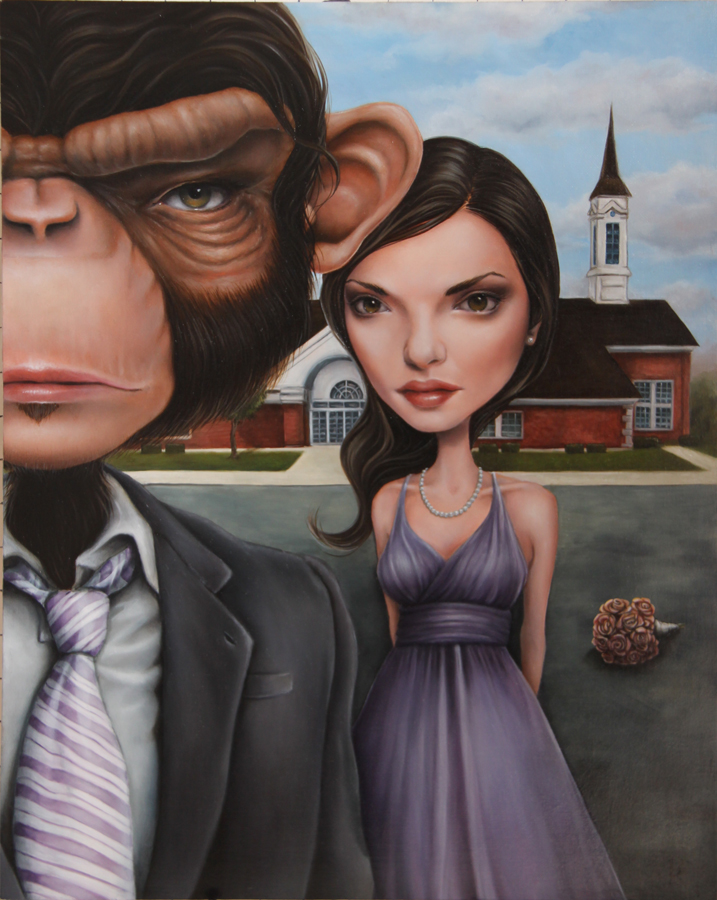
CM: Ken, what was your childhood like in America’s so-called Rust Belt? Was growing up in Flint, Michigan as harrowing as depicted in Michael Moore’s film Roger & Me? Was your family particularly artistic or eccentric and did they support your creative pursuits? Was your comedic IQ evident at a young age? Any clues you can give us that would provide insight into your current work?
Ken: I had a great childhood growing up in Flint. It has seen better days, but I really hope it makes a come back. My Family has always been supportive/patient of my creativity. My Mom has quite a large stash of my early scribbles. When I was a kid I loved drawing, making things from junk and building model kits.
“Where the Wild Things Are” has always been my favorite book. Maurice Sendak has such a great style. I still have my tattered original copy of the book. I loved Godzilla and Star Wars, anything with monsters or spaceships. Hot Rods were also a big deal to me as a kid. My parents would take me to see the custom car shows that came through Flint every year. So, I guess my tastes really haven’t changed much.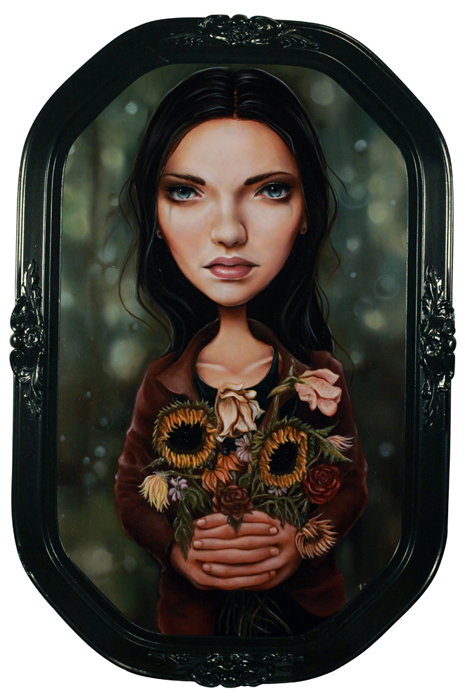
CM: As a child, what was your favorite dinosaur? (As you can tell, this interview will be a serious but hopefully not overly invasive probe of your psyche. Whether your choice is an herbivore, carnivore, sea dweller, etc, your chosen dinosaur will be submitted to Creep Machine’s resident anthro-paleontologist for analysis, helping us glean further insight). You are permitted to cite a Kaiju monster from Japanese cinema in lieu of a dinosaur (we have teratology experts on staff as well).
Ken: Definitely a T-Rex, he was the king of the dinosaurs, though Godzilla and Gamera are also pretty awesome.
My first showing was at a Kindergarten parents’ night. They showed my drawing of a Brontosaurus, displayed on a little easel. I don’t know why I drew a Brontosaurus rather than a T-Rex. Maybe I didn’t think I was ready for that kind of pressure in my first show.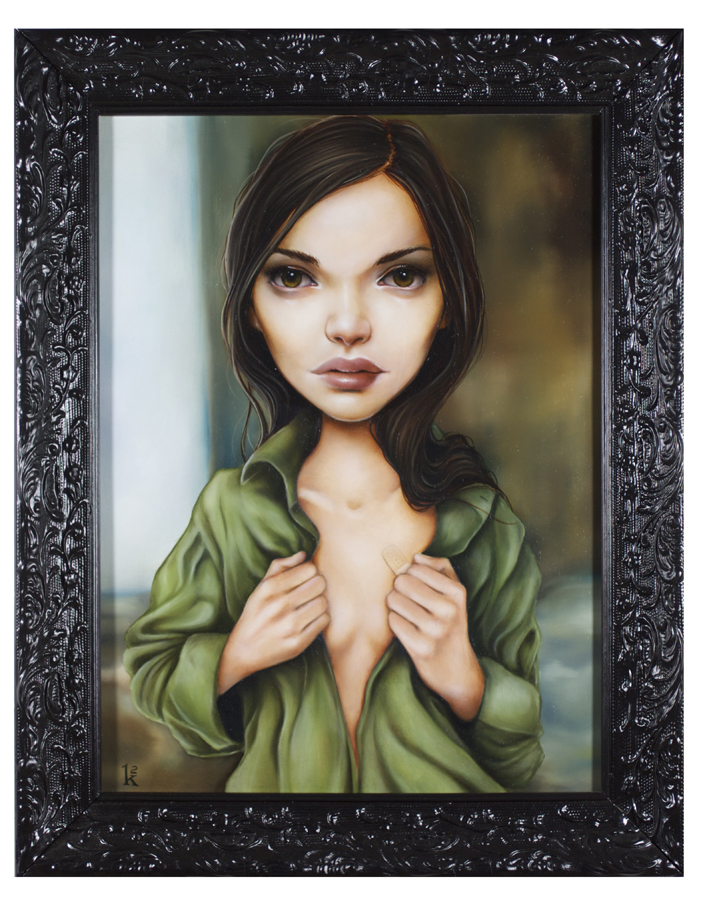
CM: Later in life you spent about 7 years in Chicago before finally relocating to the San Francisco Bay Area in Northern California in 2007. Were those relocations fraught with any bit of culture shock or were they welcome and maybe necessary changes?
Ken: Before I left Chicago, I was living two floors above a nightclub, so moving to the suburbs in California was quiet. I mean REALLY quiet. That took a lot of getting used to. If you were out in Chicago and it was quiet like it is here, you can be pretty sure you’re the last one alive after some kind of apocalypse. Also, I learned after being gone for just a year that I have completely lost my parallel parking skills. Who would have thought that was such a fragile skill? The main benefit of moving was to allow myself to focus on painting full-time. In Chicago, I juggled a full-time day job while painting nights and weekends. I was lucky if I could swing 4 hours of sleep a night. It wasn’t pretty and I didn’t feel like I could keep that up for much longer. All of the California sunshine does help the paint dry faster, but I do wish it snowed here occasionally…
CM: The initial impetus for including anthropomorphized Simians into your work was simply to terrorize your best friend and his maimouphobia (aka pithikosophobia) affliction in a fun way. Has it proven effective? Does he still possess an irrational fear of the creatures?
Ken: No, Jimmy has gotten over it. In fact, I think he actually forgot about his fear of monkeys all together (or he was faking the whole time). so maybe this sort of therapy is successful? When he first moved away I would send him boxes of thrift store monkeys. One year he decorated his entire Christmas tree in monkeys.
CM: As your work evolved, you have confided that sometimes the monkeys (and other anthropomorphized animals) in your paintings are a personification of you. Is this a means of self-deprecation in order to keep things on a lighter note?
Ken: Sometimes. Also, the chimp is much cuter then I am, so I’m guessing he appeals to a broader audience.
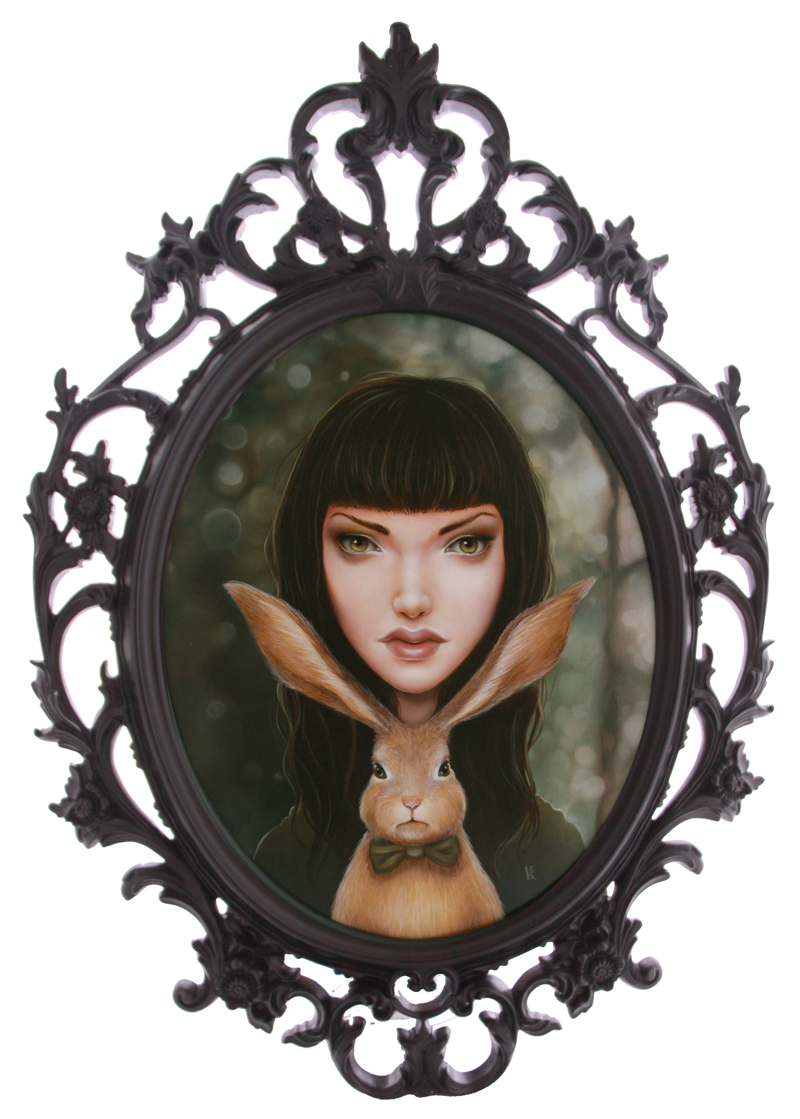
CM: An artist’s work evolves over time, along with those of us who imbue it with personal meaning. Is it important to you that others understand your work? Are you comfortable with baring your fears and desires on canvas? You employ humor to great effect in many of your works. Is it fair to suggest that your sense of humor is in effect sometimes a personal coping mechanism? And maybe a means of keeping your intended meaning less transparent than is necessary? Are you okay with a large contingent of the “art community” potentially not being able to see past the joke?
Ken: Yeah, it definitely can serve as a coping mechanism. I like to keep the paintings ambiguous. I do think it is important for people to understand the work, but if it’s not self-evident then I’d rather let it be “just art”. Also, plenty of times, viewers have made up much more interesting stories than I intended, so that works too.
CM: Your collective body of work can easily be interpreted as an ode to femininity, especially the portrait paintings. Any specific motivation behind your primary subject matter?
Ken: I’ve been painting women as my main subject matter for quite a few years now. I never get tired of painting them. I think that they make perfect storytellers.
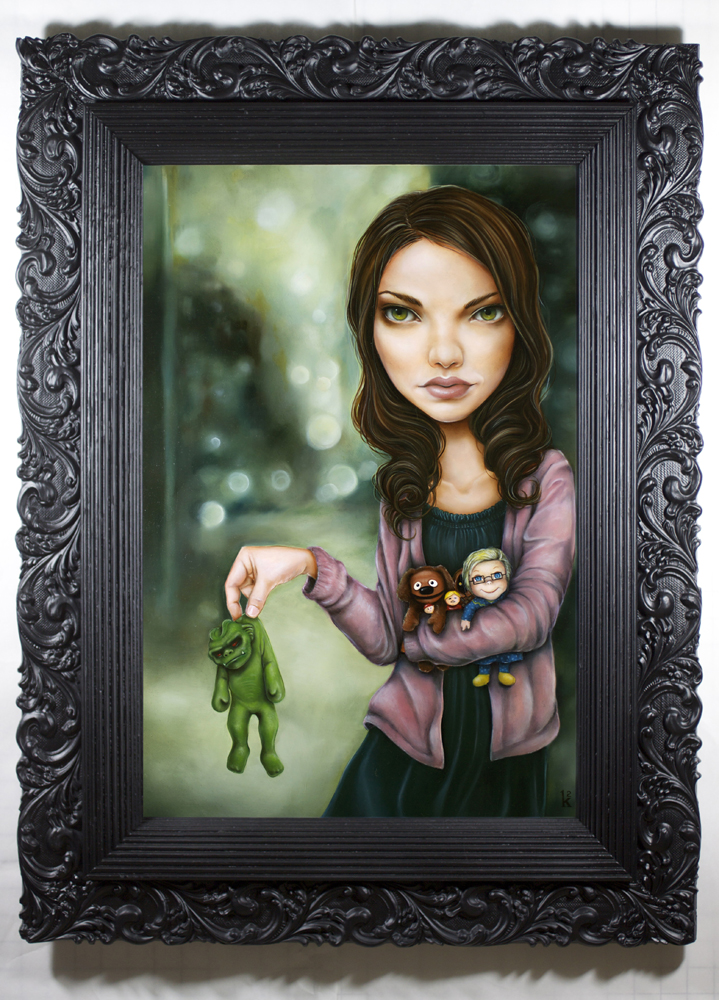
CM: Your girls’ beauty and elegance can also be seen as the lure of the siren’s web, however. Sometimes you can’t resist making less-than-subtle commentary on gender relations, with, of course, a dose of your requisite sense of humor. Surviving the treacherous terrain of modern day relationships, especially those of a highly volatile nature, isn’t easily done without casualties in the world you depict. Do you consciously try to mask these ideas with humor for the very reason they can be personal and sensitive issues? Do you get a lot of feedback about this aspect of your work? Are there differences in the way men and women respond to your paintings?
Ken: I wouldn’t say that I’m masking issues as much as I’m exaggerating them to punctuate what I’m trying to express. And, basically, the added tension of murder, betrayal, possession or heartbreak just makes it more fun to paint. I use personal experiences and dreams as a starting point, but along the way they are rearranged and exaggerated. Troublemakers are much more fun to paint than saints. I usually get similar reactions from both men and women. Although most of the paintings are bought by men.

CM: Your work is hardly insulated from the dire conditions of today’s world. As evidenced by your works “Harbinger”, “Fishing”, and even “Security”, you will occasionally venture into darker territory. Are you compelled by any specific reason to at least subconsciously acknowledge the heart of darkness every now and then? Can you talk a little bit about “Harbinger”? Do you recall how that piece originated? And how about “Security”?
Ken: I do occasionally visit the darker subject matter, it kind of depends on where my mind is at. I meant “Harbinger” as a more literal version of the little storm cloud that follows you around when you are down in the dumps. She is holding the string, so the feeling of doom is self-inflicted. “Security” is about isolation and insecurity. The Skeletor figure is the wall that you hide behind to protect yourself from the unknown. The “unknown” depicted as the out of focus figure in the background. “Fishing” is about blame and guilt. The skull represents the “issue”, which is lined up over the blurry figure’s head in the background. The blurry figure may or may not be the cause of the “issue”.
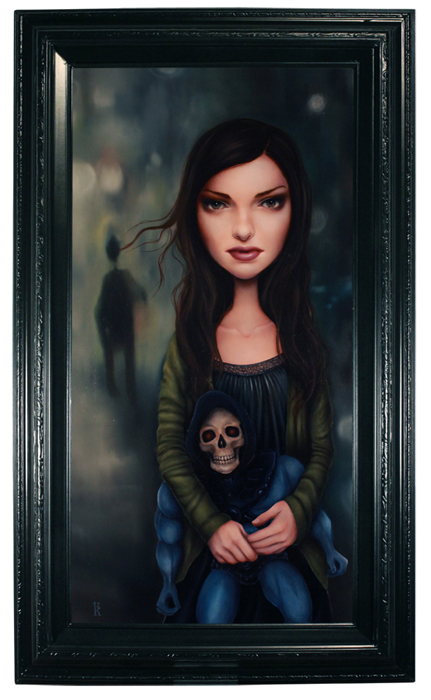
CM: Can you tell us a bit about your technical and/or creative process? Do you keep a sketch book? Do you use a magnifying lens for the near-microscopic details? Your preferred mediums now seem to be oil on canvas or board. Have you experimented with other mediums? In the past you have worked with an airbrush, with sculpture, etc. Why did you ultimately settle on oil painting?
Ken: My creative process is kind of messy. It begins with an idea, like a memory with potential or a fun play on words. Then I scribble it onto a piece of typing paper. If it has a tricky composition I will draw a rough version and transfer it to hardboard, otherwise I will draw directly on the surface. I prefer using loose paper, instead of a proper sketch book. I have several folders of rough sketches and ideas filed away. No magnifying glass, just a lot of squinting. I came to settle on oil paint because I really like the depth that I can get from building the layers. Also, I love the longer drying time that oil offers. I have a tendency to rework things, so this is very helpful. I have wiped away many a head. I also love sculpting and mixed-media assemblage. I hope to get back to spending more time on that at some point. I worked with airbrush and acrylic for many years. I still occasionally use acrylics for time sensitive projects, but I prefer oil. I haven’t used my airbrush in years. I’ve been reading up on resin toy making, so hopefully something will come of that shortly.
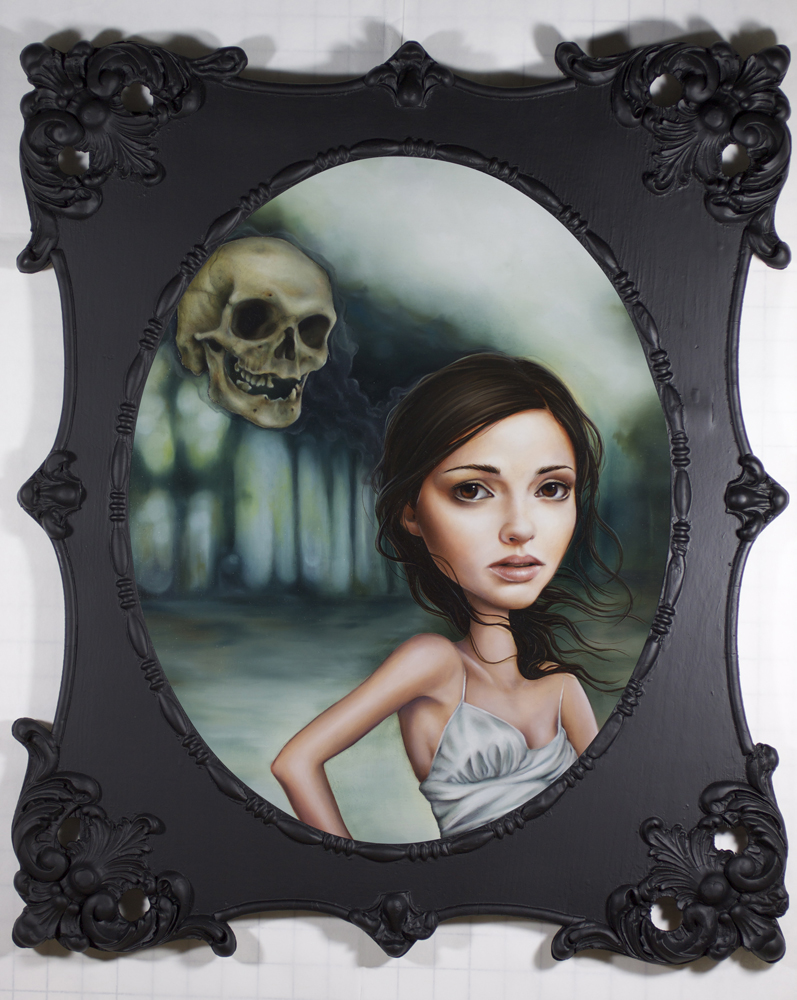
CM: As you continue refining your work, it appears you are steadily but subtly experimenting with your backgrounds (i.e. the glimmer of night lights, sunlight as filtered through foliage or the headlights of an oncoming car). And although not nearly as extreme as say Charles Schulz’ Peanuts characters, you’ve also experimented to varying degrees with the levels of afflicted hydrocephalus in your girls (i.e. “cranial endowment” as you’ve termed it). Very few artists (such as Mark Ryden or Joe Sorren, and now yourself) are adept at pulling this off. Are these stylistic flourishes ones that evolved naturally or is it a result of experimentation and trial and error?
Ken: The bokeh style backgrounds I’ve been working with lately are a lot of fun to paint, but sometimes I prefer to place the characters at the scene of the crime.I would like to blame the cranial endowment on the artist that drew my caricature as a child at Cedar Point amusement park. I have a big head, but c’mon!
Painting the head is my favorite part, so I guess it makes sense that they are larger than life. I used to paint large scantily clad women on doors (the “Door Whore” series. Yeah… classy). They all had large heads. I kept the scale, but changed the subject matter.CM: Speaking of Charles Schulz, probably the only author/artist that provides entry level philosophy for children… Which Peanuts character do you identify with most and why? (This is the 2nd of our Rorschach-style psychological probes).
Ken: Linus (with a dash of Pigpen). I’m still waiting for the Great Pumpkin.
CM: It isn’t difficult to imagine your art-making process as a meditative and perhaps even self-exploratory experience. Do you ever think of your work process in those terms (i.e. cathartic, therapeutic, etc)? As for your work environment, do you prefer to paint in silence, or do you listen to music or have the TV on for background noise? Are you nocturnal or do you work best during the day?
Ken: Painting is definitely cathartic. A teacher of mine once described my work as a Sin-eater. Painting definitely keeps everything in check for me. I prefer to paint during the day because the light is better. However, I do tend to be more productive at night. My sleep schedule shifts depending on upcoming deadlines. I usually put in a movie that I have seen a million times, that way it keeps me company but isn’t distracting. I have listened to the DVD menu for Goodfellas for hours at a time without realizing it. I used to listen to music, but for some reason I haven’t been lately.
CM: In recent years, you have achieved relatively good success as an artist without much fanfare. A hallmark of this corner of the art world is hype amplified out of all proportion. Yet, without being the beneficiary of the incessant campaigning from various cliques or coteries, you’ve managed to build and sustain an avid, loyal, and ever-growing following. It must be gratifying, yet frustrating at times, I imagine. Do you feel you have fully adjusted to your career as an artist? What are things you like and dislike about exhibiting your work and having to delve into the business side of things?
Ken: Yes, “gratifying, yet frustrating” is a bit of an understatement. I enjoy the creative process and painting. I find it challenging to make the time to keep up with all of the social media and networking part of the job. That can be a full-time job in itself! Also, openings can be tough. I’ve never been very comfortable in the spotlight, I’m kinda fidgety.
CM: Thank you for taking the time out of your busy schedule! Any final words you’d like to say to the fans of your work and to the readers of Creep Machine?
Ken: Thank you, Joe and Josh, for taking the time and having interest. Thank you readers for taking the time to read this. I really hope I didn’t sound like an idiot.
Thanks Ken and Joe for a great interview. Make sure you stop by Ken’s homepage for more work, and join his newsletter to keep up with current happenings.
Ken Keirns Homepage

